Saturday, May 23, 2026

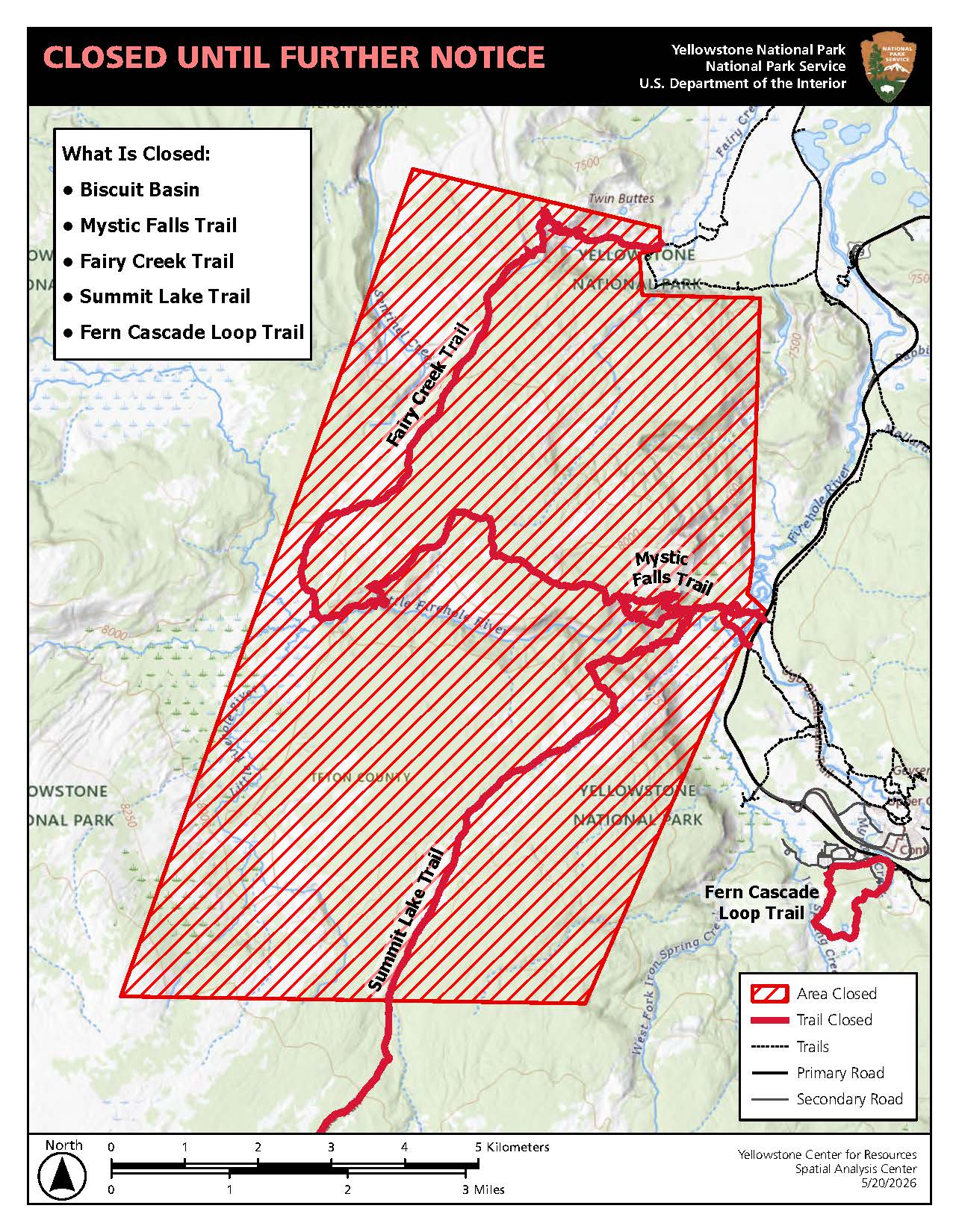
Update: Yellowstone lifts several trail, backcountry campsite and fishing closures near Old Faithful following May 4 bear incident

Temporary trail, backcountry campsite, and fishing closures remain in effect northwest of the Old Faithful area following a bear incident earlier this month.
Emergency responders, including law enforcement, EMS personnel and interagency partners, responded to the scene and provided aid before transporting two male hikers, ages 15 and 28, from the area by helicopter.

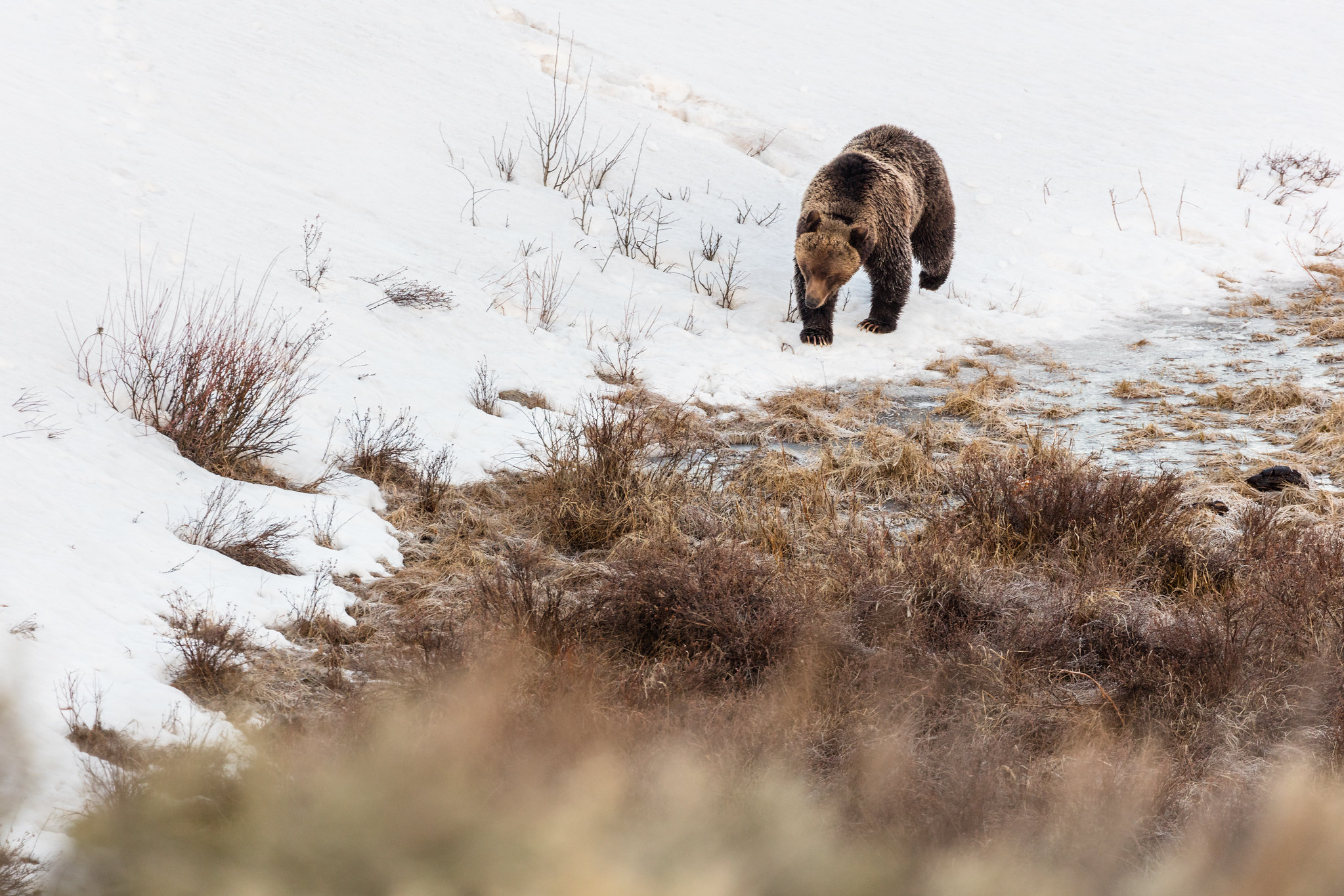
Based on evidence collected so far, park staff believe a female grizzly bear with two or three cubs-of-the-year (cubs in their first year of life) were involved in the encounter. This incident remains under investigation, and there are no further details to share at this time.

Geyser basin boardwalk areas remain open.

Visitors are required to follow all posted closures. Entering closed areas can put both visitors and responders at risk.


              ************************************************************************************

Check out our online trail guides:


Friday, May 22, 2026

Opening of Wyoming section of the Beartooth Highway (US-212) delayed due to winter storm

The opening of the Wyoming section of the Beartooth Highway (US-212) from the junction of WY-296 (Chief Joseph Scenic Byway) to the Montana state line, originally scheduled for May 22, is delayed due to a winter storm. It is now scheduled to open Saturday, May 23, conditions permitting.

Yellowstone road crews are clearing heavy drifts of snow across the road. Crews, in coordination with Montana teams, will continue to monitor weather, re-evaluate conditions on Friday, and open the road as soon as it is practical and safe for travel.

Once open, temporary travel restrictions or closures can occur at any time without notice. Prepare for winter driving conditions, have flexible travel plans, and watch for quickly changing weather conditions.

Check for road status and updates on the Montana and Wyoming departments of transportation websites. 


              ************************************************************************************

Check out our online trail guides:


Thursday, May 21, 2026

The first external frame rucksack

In 1887, Henry C. Merriam patented the first external frame rucksack. During the Civil War, Merriam was assigned command of the U.S. Colored Troops in Louisiana, and led them during the Siege of Port Hudson, as well as a strategically important attack on Confederate positions during the Battle of Fort Blakely in Alabama. He was later awarded the Medal of Honor for making his “most gallant assault” during the battle, which was the last major conflict of the war. Though he was a colonel in the U.S. Army when he received the patent, Merriam retired as a major general in 1901. His innovative pack was made with drab duck canvas, which was attached to a light steel frame. In addition to two shoulder straps, the pack featured several leather straps that allowed an infantryman to attach his bedroll and canteen to the frame, instead of having them rest on his chest and hips. The most important feature, however, were the two hardwood rods that extended from the sides of the pack to leather pockets on a half-belt, which rested across the lower back and hips. This system allowed the pack to elevate off the back and shoulders, and thus transfer the weight of the load onto the hips. Though he tried in vain to sell his invention to the U.S. Army, he was only able to sell a few thousand packs to the New York National Guard, and the French and Austrian armies. To his lifelong dismay, the pack never caught on as expected. Here’s a U.S. Infantry soldier demonstrating the Meriam Pack:
You can read about the evolution of backpacks – from “Otzi the Iceman’s” wooden frame rucksack to Greg Lowe’s internal frame pack - in Ramble On: A History of Hiking.


                *******************************************************************************

Virtually no one went hiking before the 19th century. What occurred that inspired ordinary people to take a walk through the woods for pleasure? Ramble On: A History of Hiking explores the rich history of hiking, and how it evolved into one of the most popular pastimes in the world.


Wednesday, May 20, 2026

Random photos from New Mexico

Last week, Kathy and I returned from from our trip to New Mexico. Here are a few photos from the trip (all taken by Kathy).

In the spirit of the 100th anniversary of Route 66, we stopped at the Route 66 Auto Museum in Santa Rosa:
The view from Atalaya Mountain north of Santa Fe:
A bone fragment from St. Francis Xavier (patron of the greatest university in America!), exhibited in The Cathedral Basilica of St. Francis of Assisi in Santa Fe:
A mariachi band at the Del Charro Saloon in Santa Fe. Great music, and a great quesadilla!
The famous spiral staircase in the Loretto Chapel in Santa Fe. Its existence and construction is a pretty amazing story:
The San Francisco de Asis church in Taos. This adobe mission was constructed between 1772 and 1816. Ansel Adams took several iconic photos of the church in 1929. If you ever get a chance to visit this wonderful site, be sure to stop for lunch at the Ranchos Plaza Grill. You won't regret it...
The Rio Grande Gorge bridge stands 650 feet above the river below, making it the fifth highest bridge in the United States. This is the original “Bridge to Nowhere.” During its construction in the 1960s, funding didn't exist to continue the road on the other side, thus leading to its nickname. There's a trail that extends south from the bridge for several miles if you wish to see this incredible geological feature up close. The gorge has the appearance of being a crack in the Earth's crust:
On our final day in the state, we intended to hike to Gold Hill near Wheeler Peak. Unfortunately, lingering snow pack conspired to thwart our plans. At roughly the 2.75-mile mark we began to encounter snow patches, which proceeded to get worse the higher we climbed. At roughly the four-mile mark, we finally threw in the towel. We thought we would rise above the treeline at some point, and thus out of the snow, but there was no end in sight. As we descended from our highpoint we snapped a few photos in a small meadow that looked towards Wheeler Peak and the Taos Ski area. Though the photo below seemingly indicates that massive amounts of snow were still around at this point, this view is of the north side of those mountains. We were climbing the south side of Gold Hill. The Taos Ski area webcam showed very little snow on Gold Hill the day before, but the trees at the mid elevations hid the lingering snow.


              ************************************************************************************

Check out our online trail guides:


Monday, May 18, 2026

How art inspired hiking

Though it may sound strange, or maybe even surprising, but art played an important role in the development of early American tourism and hiking. Specifically, it was a mid-nineteenth-century art movement known as the Hudson River School that celebrated the pastoral landscapes of our fledgling republic. The significance of the movement, whose artists were influenced by Romanticism and nationalism, was that it helped to usher in the acceptance and appreciation of the American landscape. It also encouraged Americans to visit the places depicted in their paintings. The founder of the movement, Thomas Cole, traveled to the Catskill Mountains for the first time in 1825. One of his first paintings, The Falls of the Kaaterskill, portrayed one of the highest waterfalls in the eastern United States, which in turn helped to make it one of America’s first tourist destinations.
Other notable artists from this genre include Albert Bierstadt and Thomas Moran, both of whom became famous for their paintings of the American West. In 1839, Cole painted A View of the Mountain Pass Called the Notch of the White Mountains (Crawford Notch), which by that point had already been established as America’s first hiking destination.
You can read about the crucial role the White Mountains of New Hampshire played in making hiking a national pastime in Ramble On: A History of Hiking.


Sunday, May 17, 2026

National Park Service Reminds Visitors to be Bear Aware as Spring and Summer Bear Activity Increases

The National Park Service is reminding visitors to take extra precautions in bear country following recent bear incidents in several national parks.

Spring and early summer are periods of increased bear activity in many parks. Bears may be moving through habitat, searching for food or protecting cubs. Visitors can reduce the chance of a dangerous encounter by staying alert, hiking in groups, making noise in low-visibility areas, storing food and trash properly and never approaching bears.
“National parks are wild places, and wildlife safety is visitor safety,” said Jessica Bowron, Comptroller, Exercising the Delegated Authority of the Director. “Simple actions, like giving bears space, securing food and knowing what to do before you enter bear country, can protect visitors and bears.”

Visitors should check current park alerts before their trip and follow park-specific bear safety guidance. Bear species, terrain, food storage rules and bear spray recommendations vary across the National Park Service.

Core safety reminders include:

* Never approach a bear.
* Stay alert and avoid headphones on trails.
* Hike in groups when possible.
* Make noise near streams, dense vegetation and blind corners.
* Store food, trash and scented items properly.
* Carry bear spray where recommended and allowed.
* Never run from a bear.

If you encounter a bear, stay calm, speak in a steady voice, back away slowly and do not make sudden movements. Visitors should report bear encounters to park staff as soon as it is safe to do so.

For park-specific bear safety information, visit the park’s website before arrival.


              ************************************************************************************

Check out our online trail guides:


Friday, May 15, 2026

On this date in hiking history: The most important camping trip ever

The following is an adaptation from Ramble On: A History of Hiking.

On this date in 1903, John Muir commenced a historic three-night camping trip with President Theodore Roosevelt in Yosemite. Most historians now regard this as the most important camping trip ever.

Thirty years prior, John Muir moved to Oakland, California, and began writing articles for several leading magazines that brought national attention to himself and his causes. In addition to writing about his wilderness travels, Muir lectured his readers about nature, conservation, and the preservation of wild places. He also brought attention to the damage being inflicted on wilderness as a result of the progress of man. Muir’s advocacy and influence helped to establish Yosemite, Sequoia and the General Grant Grove as national parks in 1890. In subsequent articles he promoted the creation of Petrified Forest, Grand Canyon and Mount Rainier as well, all of which eventually led to him becoming known as "The Father of our National Parks."

Muir’s writings eventually caught the attention of President Theodore Roosevelt. While touring the American West in 1903, Roosevelt arranged to meet with Muir in Yosemite. Traveling by horseback, the two men, along with two rangers and a packer guide, camped three nights in three different locations around the park.

On their first night, the party camped under the Grizzly Giant in Mariposa Grove. Roosevelt reportedly bedded down on a pile of 40 wool blankets that night.
On the second night, the party camped near Sentinel Dome. That evening, a surprise late-spring snowstorm dumped 5 inches of fresh snow on the campers. The next morning, Muir and Roosevelt posed for what would become their famous photo at Glacier Point. What happened to all that snow? Perhaps it was late in the morning when the photo was taken, and thus the snow had already melted.
American Heritage magazine claims that Roosevelt was overcome with emotion after witnessing the sublime beauty of the Yosemite Valley from this lofty perch. A passage in the article states:
Casting his eyes now on what many believed was the most spectacular panorama in the nation, the nation that he led, Roosevelt felt a welling of emotion. Not only was it a sight of awesome beauty and grandeur; it was an immense responsibility. Though, if tears streaked his face, as was reported, you would never know it from the photo. The photographer, who took two shots of the pair and two of Roosevelt alone, made sure of that.
The March 1959 edition of Yosemite Nature Notes also confirms this little known tidbit in American history: “It is said that he cried from sheer emotional joy as he viewed the floor of the Valley from Glacier Point.”

Perhaps sensing Roosevelt was now in the proper frame of mind, Muir felt confident that he could persuade the President on his preservation views and concerns later that evening.
On their third and final night in the park, the two towering figures camped along the edge of Bridalveil Meadow in the Yosemite Valley. Around the campfire that evening, Muir urged the President to return the California State grant lands of the Yosemite Valley and Mariposa Grove back to the federal government so that they could be incorporated into Yosemite National Park (established in 1890). He also spoke about the broader needs for more wilderness protections across the country. Muir later bragged to a friend that he had “stuffed [Roosevelt] pretty well regarding the timber thieves, and the destructive work of the lumbermen, and other spoilers of our forests." His lobbying efforts had their desired effect. In 1906, Roosevelt signed the Yosemite Recession Bill, which withdrew the Yosemite Valley and Mariposa Grove from the state of California and incorporated them into Yosemite National Park. Moreover, after that fateful camping trip, Roosevelt would proceed to establish 3 additional national parks, 143 national forests, 18 national monuments, 51 federal bird reserves and 4 national game preserves. In all, Roosevelt would place roughly 230 million acres of public land under federal protection during his presidency.


                *******************************************************************************

Virtually no one went hiking before the 19th century. What occurred that inspired ordinary people to take a walk through the woods for pleasure? Ramble On: A History of Hiking explores the rich history of hiking, and how it evolved into one of the most popular pastimes in the world.


Thursday, May 14, 2026

Bear Encounter Victim Identified

This news is a little old, but I've been out of town, and thought the story was still important. Sadly, a hiker was killed in Glacier National Park last week. Here's what the park has released so far:

The body of a missing hiker has been recovered and identified as Anthony Pollio, a 33-year-old man from Davie, Florida. Pollio’s body was discovered by search and rescue crews at approximately 12 p.m. on Wednesday, May 6, in Glacier National Park. The National Park Service withholds victim identity until 72 hours after next-of-kin notification.

On Sunday, May 3, Pollio communicated plans to hike the Mt. Brown Trail toward the Mt. Brown Fire Lookout. Park officials were notified of Pollio’s disappearance on Monday afternoon and initiated search and rescue operations.

Search and rescue teams located some of Pollio’s personal items along the Mt. Brown Trail approximately 2.5 miles from the trailhead, which prompted a focused search of the surrounding area. Pollio was discovered deceased approximately 50 feet off the trail in a densely wooded area with injuries consistent with a bear encounter.

The sequence of events leading to the bear encounter remains under investigation; however, evidence suggests that this was a surprise encounter.

Temporary Trail Closures
The section of trail where the incident occurred has been temporarily closed while the investigation continues (it appears it's now open). Park staff are working to determine next steps based on field assessments and wildlife behavior monitoring.

Find up-to-date trail closure information on the Trail Status Reports page.

Additional background
Media reports indicate that Pollio hiked to the lookout on Mt. Brown to watch the sunset. Thus, not only was he hiking at dusk or even in the dark, but he was hiking alone. Combined, these two facts are a recipe for disaster in grizzly country.

The last human fatality caused by a bear in Glacier occurred in 1998 in the Two Medicine Valley. The last time a bear injured a human was in August 2025.


              ************************************************************************************

Check out our online trail guides:


Wednesday, May 13, 2026

The significance of the Industrial Revolution on hiking

The following is an adaptation from Ramble On: A History of Hiking.

While overcoming a fear of mountains and the gradual breakdown in the social stigmas associated with walking certainly enabled hiking to germinate, I would argue that the single most important event to spur the development of hiking was the Industrial Revolution. The social changes brought about by industrialization were profound. As explained in much more detail in Ramble On: A History of Hiking, industrialization triggered a massive backlash from certain segments of society, which inspired movements in art, philosophy and religion. These movements, in turn, would motivate people - in one way or another - to visit wilderness areas for recreational purposes. As industrialization progressed, especially in America, it gave rise to the labor movement, which eventually resulted in increased wages and significant reductions in the average number of hours worked each week. Thus, workers began to enjoy more free time, many of whom pursued recreation in the great outdoors. Industrialization also gave rise to railroads, automobiles and roads, which provided people with the ability to travel more easily to wilderness areas. As a result of these social transformations and movements, hiking emerged as a pastime. Though it was only a fringe activity in the early 1800s, the sport grew steadily through the Great Depression. After World War II, however, it exploded, and has now become one of the world's most popular outdoor activities.

Learn more about Ramble On: A History of Hiking on my author page.


                *******************************************************************************

Virtually no one went hiking before the 19th century. What occurred that inspired ordinary people to take a walk through the woods for pleasure? Ramble On: A History of Hiking explores the rich history of hiking, and how it evolved into one of the most popular pastimes in the world.


Monday, May 11, 2026

On this date in hiking history: Glacier becomes America’s 8th national park

On this date in 1910, Glacier became America’s 8th national park. Take a step back in time and check out this quick tour of the park from the 1920s:


                *******************************************************************************

Glacier National Park preserves more than a million acres of some of the most spectacular scenery on Earth. With more than 740 miles of trails meandering throughout this vast park, how will you find and choose the most scenic and rewarding hikes?

Exploring Glacier National Park takes all the guesswork out by focusing on the most amazing hikes, and provides you with handpicked recommendations that will allow you to make the most of your trip to Glacier:


Thursday, May 7, 2026

A Young Granite Park Chalet

The two photos below of the Granite Park Chalet in Glacier National Park were taken by T. J. Hileman in 1925, just ten years after it was constructed by the Great Northern Railway. The rustic lodge was the last of the nine backcountry chalets built by the railroad, all of which were part of an interconnected system of trails, tent camps, backcountry chalets and frontcountry lodges [more details on this system here]. All were constructed to provide comfortable accommodations within Glacier during the era before automobile travel become an important mode of transportation. Both Sperry and Granite Park, the only chalets that survive to this day, still offer overnight accommodations for hikers. Both are National Historic Landmarks.

Compared to Sperry Chalet, the Granite Park Chalet is much more basic, and is essentially a simple hiker's hostel, with virtually no amenities. It has 12 guest rooms, each with 2 to 6 bunks. Although there's no electricity, the common-area kitchen does have a propane stove that you can use to cook a warm lunch or dinner. The chalet also sells packaged foods, beverages, snacks, and bottled water to day hikers.

Although accommodations are limited, the chalet is still a popular destination for hikers on the Highline Trail, as the upfront views of Heavens Peak are second to none:
Here's another photo of a "man playing with bear at Granite Chalet" in 1924. This photo was taken by John Morten:


                *******************************************************************************

Glacier National Park preserves more than a million acres of some of the most spectacular scenery on Earth. With more than 740 miles of trails meandering throughout this vast park, how will you find and choose the most scenic and rewarding hikes?

Exploring Glacier National Park takes all the guesswork out by focusing on the most amazing hikes, and provides you with handpicked recommendations that will allow you to make the most of your trip to Glacier:


Saturday, May 2, 2026

Gran Teton posts construction updates

Gran Teton National Park posted this blurb on their social media yesterday:
Planning a trip to Grand Teton National Park this spring? Most of the park is OPEN and ready to explore 🏔️

Scenic drives, hiking trails, visitor centers, and campgrounds are available across much of the park.

🚧 A few construction areas to plan around:

• Death Canyon Road/Trailhead: closed

• Moose-Wilson Road: open between Granite Entrance and Rockefeller Preserve

• Moose/Teton Park Road area: occasional short delays possible

• Taggart Lake Trail: hiking detour in place

✨ Bottom line: classic Grand Teton experiences, like Colter Bay and driving the Teton Park Road are here—just allow extra travel time and check conditions before you go. 🔗 nps.gov/grte/planyourvisit/road-construction.htm


              ************************************************************************************

Check out our online trail guides: