Tuesday, March 31, 2026

Why did hiking become so popular across the globe?

The following is an adaptation from Ramble On: A History of Hiking:

Since the dawn of mankind, humans have walked the planet to hunt, forage, explore, trade goods with neighboring communities, and migrate to other regions. At some point in our long evolution, we realized we didn’t need a utilitarian reason to walk. Somewhere along the line we discovered the joy of traipsing through the countryside, observing the beauty of a wildflower, watching wildlife in their natural habitat, marveling at the roar of a waterfall, or contemplating the scenic grandeur from the top of a mountain. Is this a fairly recent phenomenon, or is this an innate characteristic of human beings?

While history has preserved a few examples of men scaling mountains for an assortment of reasons prior to the early modern era, these feats appear to be extremely rare. Before the fifteenth and sixteenth centuries, mountains were commonly seen as dangerous and mysterious by most Western cultures, at least according to prevailing wisdom. People from the Middle Ages purportedly regarded them with fear, loathing and superstition. Moreover, they thought the alpine world was inhabited by evil spirits, witches, wild beasts and bandits. Some men even swore affidavits before magistrates that they had seen dragons in the mountains.

However, as the Renaissance and Enlightenment periods progressed and spread across Europe, fear of mountains slowly began to subside, and more men began venturing into the highlands. Several modern historians contend that attitudes towards mountains started to shift as a result of the religious and philosophical tenets of natural theology, which proposed that God is revealed through reason and nature, rather than sacred texts, divine revelation or supernatural beliefs. They argue that individuals from this era began to realize that fear and loathing of mountains wasn’t justified. The perception that they were inherently dark and evil inevitably changed after it was understood that it was God who had created them. Consequently, people started viewing mountains as images of the Creator, as sources of spiritual inspiration, or even as proof of God’s existence. Leslie Stephen, on the other hand, claimed that attitudes simply evolved in conjunction with the revolution in ideas and thinking that occurred during the Age of Enlightenment. As one of the most famous British climbers from the “Golden Age of Alpinism,” Stephen argued in 1868 that "The history of mountaineering is, to a great extent, the history of the process by which men have gradually conquered the phantoms of their own imagination."

By the mid-1700s, we begin to see the first documented rambling and walking excursions. While the historical record seemingly indicates that mountaineering preceded hiking by several decades, or even centuries, it doesn’t necessarily mean that people didn’t hike or walk for recreational purposes prior to this timeframe. Rather, it seems more likely that those who did set out on foot never would’ve considered a leisurely walk in the countryside to be a noteworthy event. Therefore, very few individuals would’ve taken the time to record their rambles for posterity, even if they were literate. As a result, hiking doesn’t have a date of birth, or even an approximated timeframe for its origins. It seems most likely that walking for pleasure has always been a natural form of recreation that evolved over time to a point where individuals began to take it more seriously, whereupon we begin to see the first descriptions of walking excursions in diaries, letters, poems and travelogues.

The roots of hiking and walking for pleasure were firmly established by the late 1700s, especially in Great Britain and certain parts of Europe. However, during the earlier part of the century, walking was generally looked down upon. “Respectable” citizens during this era usually rode in carriages or on horseback to travel any significant distances. For the most part only the poor walked. In Victorian England, during the mid-1800s, wandering vagrants were derogatively known as tramps, a word that would eventually refer to hikers, and now used by New Zealanders to describe backpacking.

While overcoming the fear of mountains, and the gradual breakdown in the social stigmas associated with walking certainly enabled mountaineering and hiking to germinate, I would argue that the single most important event to spur the development of hiking and walking for pleasure was the Industrial Revolution. The social changes brought about by industrialization were profound. As I explain in more detail in my book, industrialization triggered a massive backlash from certain segments of society, which inspired movements in art, philosophy and religion. These movements, in turn, would motivate people, in one way or another, to visit wilderness areas for recreational purposes. As industrialization progressed, especially in America, it gave rise to the labor movement, which eventually resulted in increased wages and significant reductions in the average number of hours worked each week. Thus, workers began to enjoy more free time, many of whom pursued recreation in the great outdoors. Industrialization also gave rise to railroads, automobiles and roads, which provided people with the ability to travel more easily to wilderness areas. As a result of these social transformations and movements, hiking emerged as a pastime. Though it was only a fringe activity in the early 1800s, the sport grew steadily through the Great Depression. After World War II, however, it exploded, and has now become one of the world's most popular outdoor activities.

You can learn more about the history of hiking on my author page.


Other excerpts from Ramble On:

* The Etymology of Hiking

* The Historic Circle Tours of Glacier National Park

* Women’s Hiking Attire During The Victorian Era

* The Evolution of Hiking Boots


                *******************************************************************************

Virtually no one went hiking before the 19th century. What occurred that inspired ordinary people to take a walk through the woods for pleasure? Ramble On: A History of Hiking explores the rich history of hiking, and how it evolved into one of the most popular pastimes in the world.


Monday, March 30, 2026

Bridger-Teton Reminds Public of Seasonal Wildlife Migration

The Bridger-Teton National Forest would like to remind the public of a seasonal recreational closure on the Pinedale Ranger District near the outlet of Fremont Lake. The purpose of the seasonal closure is to minimize human disturbance to migrating mule deer in the spring and fall.

In collaboration with the Wyoming Game and Fish Department, the Forest has implemented a no human presence closure from April 1 through April 30 and from November 1 through November 30 each year, in a crucial area along the Sublette Mule Deer Migration Route, which was designated by the Wyoming Game and Fish Department.

Data indicate deer using this migration route travel farther than any other mule deer migration ever documented, passing through many potentially life-threatening obstacles along the way. The closure area represents an important portion of the migration route, known as the “Fremont Lake Bottleneck.” This bottleneck is a top concern for mule deer managers, as this narrow segment of the migration route is critical for the passage of thousands of mule deer each spring and fall. In addition to the narrowness of the migration bottleneck, which is bordered by residential development to the south and by Fremont Lake to the north, a major concern with this area is the high level of human activity the deer must contend with as they cross Pine Creek or swim the lake outlet, move past the marina and multi-use trails at the CCC Ponds area, and cross the paved FS 111 and CR 154 roads.

Efforts have also been made to eliminate non-wildlife friendly fencing in the area, as well as the acquisition by the Wyoming Game and Fish Department of the Luke Lynch Wildlife Habitat Management Area, located just west of the proposed closure area.

Signs will be posted at key entrances to the area to remind the public of the seasonal closure.


              ************************************************************************************

Check out our online trail guides:


Saturday, March 28, 2026

FWP releases 2026–2030 Statewide Comprehensive Outdoor Recreation Plan

Montana Fish, Wildlife & Parks recently released the 2026–2030 Statewide Comprehensive Outdoor Recreation Plan (SCORP), which will provide a five-year framework to guide outdoor recreation planning, investment and coordination across Montana.

Key focus areas in the 2026–2030 SCORP include improving trail connectivity and access, expanding inclusive and accessible recreation opportunities, supporting community and economic vitality, addressing facility needs and deferred maintenance issues and balancing recreation demand with long-term conservation of natural resources.

The SCORP was developed through extensive public input, stakeholder engagement and data analysis, the 2026–2030 SCORP identifies statewide recreation trends, challenges and priorities. The plan is intended to be used by local governments, tribes, land managers, nonprofit organizations and other partners to help guide recreation planning and funding decisions over the next five years.

The National Park Service (NPS) formally approved the plan this winter. The plans is required for Montana to maintain eligibility for the Land and Water Conservation Fund (LWCF) State Assistance Program. FWP administers the LWCF program, which provides federal matching grants to support outdoor recreation development and access in communities throughout the state.

The SCORP also serves as the planning document for Montana’s LWCF program. Communities and eligible entities seeking LWCF funding are encouraged to review the plan and align proposed projects with SCORP goals and priorities.

The full 2026–2030 Montana SCORP is available at fwp.mt.gov/aboutfwp/scorp. For more information about the SCORP or the LWCF program, visit fwp.mt.gov/aboutfwp/grant-programs/land-and-water-conservation-fund


              ************************************************************************************

Check out our online trail guides:


Friday, March 27, 2026

Teton Park Road opens for spring recreation

It’s officially spring at Grand Teton National Park. The 14-mile section of the Teton Park Road between Taggart Lake Trailhead and Signal Mountain Lodge is cleared of snow and open to walking, running, biking and skating.

Starting April 10, the Craig Thomas Discovery and Visitor Center in Moose will open daily from 10 a.m. to 4 p.m.

On nice spring days, the Teton Park Road can be busy. Starting your trip at Signal Mountain, where there is ample parking, is a good alternative to the busier Taggart Trailhead area, where parking may be hard to find. In the Taggart area, visitors are encouraged to use the 10-minute loading and unloading zone at Cottonwood Picnic Area, especially for large groups or those with children.

Visitors should stay alert for park vehicles and heavy equipment on all park roads. Respect all road or wildlife closures marked by signs or barricades, and use caution as snow and ice may persist on some road sections.

Other roads, facilities, and services will open later in the spring and early summer. Some openings may be delayed or affected by construction during the 2026 season.


              ************************************************************************************

Check out our online trail guides:


Thursday, March 26, 2026

Meeting a local legend on the trail

It’s not too often that you get a chance to meet a local legend while hiking. But that’s exactly what happened to my wife and I while hiking the Skyline Loop in Mount Rainier National Park in 2013.

As we were descending from the highest point on the loop, we happened to pass an older woman ascending the trail. As we stopped and chatted for a few minutes, my curiosity finally got the best of me. I had to ask how old she was. She replied, stating she was 88 years old! In our conversation she also mentioned that she had climbed Mt. Rainier 11 years earlier - at the tender age of 77! She said she made the ascent in 19 hours straight, and bypassed the normal overnight bivouac at Camp Muir. We asked what her name was, and she mentioned that the local press had covered her climb, as she had become the oldest woman to ever climb the 14,410-foot peak.
So, when we returned home a couple of weeks later, we did a little research on Bronka Sundstrom. We promptly discovered that she's a bit of a local legend. She and her late husband have hiked, snowshoed and skied in the park on hundreds, if not thousands of occasions. We also found out that Mrs. Sundstrom was a Holocaust survivor, having been a prisoner of the Auschwitz and Bergen-Belsen concentration camps during WWII. Looking back now, we really wished we could have spent more time talking with her. If there's a takeaway from our chance meeting, it's to live life to the fullest: do the things you like more often, and if possible, do the things you dislike less. An article on the Washington Trail Association website notes that, “While official records aren’t kept, it’s likely that she has made the hike up to Camp Muir more times than anyone, except for a few professional guides.” Her last hike up to Camp Muir, located at 10,188 feet, was made at age 90.

Bronka passed away in 2023, at the age of 98. She’s quoted on The Holocaust Center for Humanity website as saying, “If it weren’t for the mountains, I wouldn’t be the person I am today. The mountains teach us of independence, strength, confidence and beauty.”

The local PBS station aired a short biography on Bronka in 2024:


You can also read about our hike along the Skyline Trail (which is among the top hikes I’ve ever taken).


                *******************************************************************************

Virtually no one went hiking before the 19th century. What occurred that inspired ordinary people to take a walk through the woods for pleasure? Ramble On: A History of Hiking explores the rich history of hiking, and how it evolved into one of the most popular pastimes in the world.


Wednesday, March 25, 2026

How hiking shorts became acceptable apparel

The following is an excerpt from Ramble On: A History of Hiking.

Generally speaking, the apparel that was available to hikers remained virtually unchanged until the 1970s. Until then, most published guides continued to recommend wool clothing in all its various forms, fabrics, knits and weaves as the basis for most hiking outfits. In his book, Vacation Tramps in New England Highlands, published in 1919, Allen Chamberlain bluntly stated that “The standardized ideal hiker’s outfit does not exist. He who would attempt
to furnish specifications for one would at once be suspected of greenness in the art of walking.” One notable exception to what was being recommended at that time came in 1913, when The Boy Scout’s Hike Book declared that it was perfectly suitable for boys to wear shorts during summer hikes. As noted by the author, the idea of wearing short pants while hiking wasn't shared by everyone at that time. By the end of the decade, however, the acceptance of shorts began to shift. While The Boy Scout’s Hike Book was specifically geared towards boys, Going Afoot, published in 1920, was geared towards the general population. The author, Bayard Christy, acknowledged that some men might prefer wearing short trousers while hiking. Prior to this timeframe, most men in Western societies seldom wore shorts, as they were mostly viewed as appropriate only for young boys. Societal views on grown men wearing shorts began to change after British soldiers stationed in Bermuda during the First World War began wearing them for relief from the stifling summer heat. “Bermuda shorts,” as they would become known as, soon spread to London and the United States. Though Christy recommended wearing army-style khaki shirts and breeches during the summer, it’s not clear whether his brief mention of shorts was directly influenced by the British military fashion. While there’s some photographic evidence of adult male hikers wearing shorts prior to 1920, the numbers began increasing by the mid-1920s.


                *******************************************************************************

Virtually no one went hiking before the 19th century. What occurred that inspired ordinary people to take a walk through the woods for pleasure? Ramble On: A History of Hiking explores the rich history of hiking, and how it evolved into one of the most popular pastimes in the world.


Tuesday, March 24, 2026

The Historic Circle Tours of Glacier National Park

The following is an adaptation from my book, Ramble On: A History of Hiking:

Almost immediately after Glacier was established as a national park, Louis W. Hill, president of the Great Northern Railway, began building a series of hotels, chalets and tent camps throughout the park. The buildings were modeled on traditional Swiss architecture, and were part of Hill's strategy to portray Glacier as the "American Alps" or "America's Switzerland." The accommodations would in-turn help the railway promote tourism to the new national park, while at the same time promote their rail line as the primary mode of travel to the park. This would also allow them to compete against their chief rivals; the Canadian Pacific Railway and the Northern Pacific Railway, who were already transporting tourists to Banff and Yellowstone.


The Belton Chalet in West Glacier, and the Glacier Park Lodge in East Glacier Park were the first two hotels to be constructed by Great Northern. Both acted as gateways from railroad depots to the interior of the park. Between 1910 and 1915, the railway also constructed eight Swiss-style backcountry chalet complexes, each connected by a network of trails. The complexes were strategically located at Two Medicine Lake, Cut Bank, St. Mary, Sun Point, Granite Park, Many Glacier, Gunsight Lake and Sperry Glacier. Tent camps were also established at Red Eagle Lake, Cosley Lake, Fifty Mountain and Goat Haunt. The chalet and tent camps were located roughly 10-18 miles apart. During their prime most of the chalet camps could host between 100 and 150 guests per night. Hill would explain to newspaper reporters that the “lodges would be located only far enough apart so that the man on foot even could make the trip and obtain sleeping accommodations,” and that “hotel accommodations of a more prestigious type or tents for the most modest could also be furnished.”


As construction on the new chalets progressed through the early 1910s, the railway also constructed the trails that would connect each of them by foot or horse travel. Because of a lack of federal funds, the Great Northern Railway assumed financial responsibility for all trail construction during this time period, but was eventually reimbursed as funding became available. Some of the earliest trails developed by the railway included Swiftcurrent Pass, Gunsight Pass, Mt. Henry, Red Gap Pass, Gable Pass, Triple Divide Pass, Piegan Pass, Pitamakan Pass and the St. Mary Lake trails. Many of these early trails were routed along Indian paths, prospector trails or old game trails. Great Northern would continue to improve or construct new trails within the park into the early 1920s. As the network of trails expanded, organized tours by horse concessionaires began to emerge. In 1915, the Park Saddle Horse Company became the sole concessionaire for the park, and began organizing a series of guided tours that utilized the existing network of chalets and trails. This included the North Circle, South Circle and Inside Trail trips, which encompassed roughly 163 miles of trails, each of which is now on the National Register of Historic Places. The company also offered the Logan Pass Triangle Trail trip, which traversed across the heart of the park utilizing routes from the other tours, as well as the now abandoned Logan Pass Trail, which I discussed in detail yesterday. The concessionaire offered a variety of options, from half-day excursions to extended trips lasting up to two weeks. Most of the so-called circle tours, however, lasted between three and five days. During the 1920 season, the company charged roughly $4.00 per person, per day to take one of its saddle-horse tours.


Although there were several variations of each of these trips, depending on the number of days tourists chose, the direction they wanted to take, as well as the evolution of routes over time, these are the routes described on the National Register of Historic Places Registration Form and various park brochures:

The North Circle: Connects Many Glacier with Cosley (aka Crossley) Lake; Cosley Lake with Goathaunt; Goathaunt with Fifty Mountain; Fifty Mountain with Granite Park; Granite Park with Many Glacier.

The South Circle: Connects Lake McDonald Lodge with Sperry Chalets; Sperry Chalets with Sun Point via Gunsight Pass; Sun Point with Many Glacier via Piegan Pass; Many Glacier with Granite Park via Swiftcurrent Pass; Granite Park with Going-to-the-Sun Road at Packer's Roost.

Logan Pass Triangle trip: Three-day trip made as follows: Many Glacier Hotel to Granite Park Chalets via Swiftcurrent Pass, thence along the west side of the Garden Wall through Logan Pass to Going-to-the-Sun Chalets, thence back to Many Glacier Hotel via Glacial Meadows and Piegan Pass. Rate for guide and horses, $12.50 per person. Going-to-the-Sun Chalets is also a point of departure for this trip.

Inside Trail: Guide and horses may be obtained for a five-day trip over the inside trail from Glacier Park Hotel, via Two Medicine Chalets, thence via Mount Morgan Pass (now known as Pitamakan Pass) to Cut Bank Chalets, thence via Triple Divide, Red Eagle Lake, to St. Mary Chalets, thence via boat across St. Mary Lake to Going-to-the-Sun Chalets, thence via Piegan Pass to Many Glacier Hotel, at the rate of $18 for each person, including boat fare, if five or more make the trip. This trip may be made in either direction.


The park visitors that took these tours were “guided by ‘cowboys,’ lunched near glacial lakes and then dined in comfort on Chinese linen and blue willow china”. Park rules dictated that the Park Saddle Horse Company had to furnish at least one guide for each ten tourists on a trip. Parties could reach as large as 180 people and 200 horses. It’s estimated that the concessionaire used more than 1000 horses during its peak, with at least one source estimating as many as 1500 head of horses. The 1922 park brochure bragged that there were "more saddle horses used in Glacier than in any other similar recreational area in the world". From everything I’ve read that record has never been surpassed.

The saddle-horse tours were the dominant method of seeing the park until the Going-to-the-Sun Road was completed in 1933. Although the tours continued for another ten seasons, they came to a permanent end after the 1942 season when America became fully involved in World War II.

Ramble On chronicles the history of the first hikers, trails, and hiking clubs, as well as the evolution of hiking gear and apparel. This broad-based book on hiking history is available on Amazon.


Other excerpts from Ramble On: A History of Hiking:

* The Etymology of Hiking

* How did hiking become so popular across the globe?

* Women’s Hiking Attire During The Victorian Era

* The Evolution of Hiking Boots


                *******************************************************************************

Glacier National Park preserves more than a million acres of some of the most spectacular scenery on Earth. With more than 740 miles of trails meandering throughout this vast park, how will you find and choose the most scenic and rewarding hikes?

Exploring Glacier National Park takes all the guesswork out by focusing on the most amazing hikes, and provides you with handpicked recommendations that will allow you to make the most of your trip to Glacier:


Monday, March 23, 2026

Uncle Tom's Trail

Beginning in 1898, park visitors could descend along a “trail” known as Uncle Tom's Trail to a viewpoint near the base of the Lower Yellowstone Falls in the Grand Canyon of the Yellowstone. Constructed by park concessionaire "Uncle Tom" H. F. Richardson, the original trail included several rope ladders and 528 steps. As a private enterprise, Richardson guided clients into the canyon, and then afterwards would provide them with a picnic lunch. This photo was taken before 1905:
In 1905, the National Park Service assumed ownership of Uncle Tom's Trail, and then proceeded to make numerous improvements to the route. In addition to removing the ropes, they reduced the number of steps to “only” 328. However, this new trail only went three-quarters of the way into the canyon. Over the ensuing years, the park made additional improvements to the stairway system. In 2019, however, they closed the trail to all visitors, presumably forever. Here’s the improved Uncle Tom's Trail in 1906:


              ************************************************************************************

Check out our online trail guides:


Sunday, March 22, 2026

How did hikers measure trail distances before GPS?

Prior to the invention of GPS, one of the principle tools used by hikers and trail builders to measure distances between two points was a measuring wheel. Also known as a surveyor's wheel, clickwheel, hodometer, waywiser, trundle wheel, and perambulator, the measuring wheel was introduced by surveyors in England in the 17th century. By the early 1900s, the hiking community was using the instrument as well.

Since its original invention, the device has undergone many improvements. By the early 1900s it had basically evolved into a bicycle wheel attached to a pole. As it does today, the instrument measures the distance between two points by rolling the device along the ground. As the wheel completes a full rotation, a mechanical counter records the number of revolutions. The total distance is then calculated by multiplying the number of clicks by the circumference of the wheel.

Myron Avery, regarded as the person most responsible for the construction of the Appalachian Trail, famously pushed a measuring wheel along the route in the 1930s, and in the process became the first person to hike its entire length (in sections). Here he is along a stretch of the Appalachian Trail in Pennsylvania:
According to an article on the Appalachian Mountain Club website, “For the first edition [of the White Mountain Guide, published in 1907], AMC cartographer Louis Cutter fastened a cyclometer, a device that measures distance based on the rotation of a wheel, to the front half of a bicycle and walked it into the mountains.” Although I couldn’t find any other mentions of its usage prior to this date, there’s a very good chance that measuring wheels were used in the White Mountains (and other locales) prior to this timeframe.

You can read more about the pioneers of trail building in Ramble On: A History of Hiking.


                *******************************************************************************

Virtually no one went hiking before the 19th century. What occurred that inspired ordinary people to take a walk through the woods for pleasure? Ramble On: A History of Hiking explores the rich history of hiking, and how it evolved into one of the most popular pastimes in the world.


Thursday, March 19, 2026

The “Blizzard Proof Jacket”

The following is an excerpt from my new book, Ramble On: A History of Hiking.

The first significant improvement in outdoor apparel was made as a result of a near-death experience during a winter fishing trip in 1935. After catching roughly one hundred pounds of steelhead salmon along the North Fork of the Skokomish River on the Olympic Peninsula, Eddie Bauer and his friend began hauling their heavy load up the steep canyon. Though it was cold and snowing, the men removed their wool coats to avoid overheating during their ascent. However, as Bauer neared the top of the climb, he realized that his underclothes had become coated with ice, and his body temperature was starting to drop. In an interview conducted several decades later, Bauer stated that he sat down next to a tree to take a
quick rest. After a short time he realized that he was becoming sleepy, which is usually an early sign of hypothermia, and fired off three rounds from his revolver to alert his friend, who was well ahead of him by this time. Fortunately for Bauer, his fishing buddy heard the shots and returned to revive him and escort him back to safety. Upon returning to his home in Seattle, Bauer immediately went to work on designing a garment that would help outdoorsmen stay warm and dry during harsh weather conditions, while eliminating the bulkiness and weight associated with heavy wool. During the following year, he introduced the “Skyliner,” the first quilted goose down jacket made in North America, and began advertising it as a “Blizzard Proof Jacket” in outdoor publications, such as Field and Stream. The breathable, lightweight coat, patterned with diamond-shaped baffles, revolutionized winter outdoor apparel. Over the next several years, Bauer designed and patented several other down-filled products, such as parkas, ski jackets, pants and sleeping bags. Members of the first American K2 expedition in 1953, as well as the first American Mt. Everest expedition in 1963, wore Eddie Bauer parkas.


                *******************************************************************************

Virtually no one went hiking before the 19th century. What occurred that inspired ordinary people to take a walk through the woods for pleasure? Ramble On: A History of Hiking explores the rich history of hiking, and how it evolved into one of the most popular pastimes in the world.


Wednesday, March 18, 2026

Avalanche Warning Issued By The Flathead Avalanche Center (updated)

BACKCOUNTRY AVALANCHE WARNING
IMMEDIATE BROADCAST REQUESTED
06:00 MDT Wed Mar 18 2026

The Flathead Avalanche Center in Hungry Horse has issued a BACKCOUNTRY AVALANCHE WARNING for the following areas:

NWS Missoula MT - MTZ001 (MTZ001)...MTZ002 (MTZ002)

* WHAT...Above-freezing temperatures, strong winds, and rain have created very dangerous avalanche conditions.

* WHERE...Slopes above 5,000 feet in the Whitefish, Swan, Flathead Ranges, and the Lake McDonald and Marias Pass areas of Glacier National Park.

* WHEN...In effect from Wed 06:00 MDT to Sat 06:00 MDT.

* IMPACTS...Natural and human-triggered avalanches are very likely. Wet loose avalanches will entrain a dangerous amount of wet debris. Weak layers buried several feet deep may fail, resulting in very large and destructive avalanches.

* PRECAUTIONARY / PREPAREDNESS ACTIONS...Very dangerous avalanche conditions. Travel in avalanche terrain is not recommended. Avalanches may run long distances and can run into mature forests, valley floors, or flat terrain.

Consult http://www.flatheadavalanche.org/ or www.avalanche.org for more detailed information. Similar avalanche danger may exist at locations outside the coverage area of this or any avalanche center.


              ************************************************************************************

Check out our online trail guides:
  • New, improved and expanded edition on the history of hiking is now available on Amazon


Tuesday, March 17, 2026

The Austin Sisters

On August 31, 1821, three young ladies from the nearby town of Jefferson, New Hampshire arrived at the Crawfords’ homestead determined to ascend Mt. Washington. In her memoir, The History of the White Mountains, Lucy Crawford noted that Eliza, Harriet, and Abigail Austin “were ambitious and wanted to have the honor of being the first females who placed their feet on this high and now celebrated place.” Although foul weather forced the excursionists to bivouac three nights along the lower slopes of the mountain, the Austin sisters became the first women of European descent to set foot atop Mount Washington. Moreover, this was likely the first mountain of any significance to be climbed by white females in the United States.
Please note: the women in this photo are not the Austin sisters, but are Hazel Peek, [an unidentified woman], and Theodora Beckwith. The photo was likely taken around the turn of the 20th century.


                *******************************************************************************

Virtually no one went hiking before the 19th century. What occurred that inspired ordinary people to take a walk through the woods for pleasure? Ramble On: A History of Hiking explores the rich history of hiking, and how it evolved into one of the most popular pastimes in the world.


Monday, March 16, 2026

Public Interest in National Parks Remains Strong as Visits Top 323 Million in 2025

The National Park Service announced last week that it recorded more than 323 million recreation visits in 2025, including over 13 million overnight stays, with 26 parks setting new visitation records.

Despite a 43-day partial government shutdown – the longest ever – the National Park Service worked to keep parks open and accessible whenever possible so visitors could continue to experience the nation’s natural and historic treasures.

Visitation data helps the National Park Service manage parks to provide safe, enjoyable visitor experiences while protecting the natural and cultural resources entrusted to its care. The Visitation Statistics Dashboard on NPS.gov provides recreation visit data for every park in the U.S. for 2025 and previous years—dating back to 1979 for some parks.

With at least one national park site in every state, the national park system offers opportunities for recreation, learning and inspiration to visitors of all ages. For an in-depth look at 2025 visitation, including individual park figures, please visit the NPS Social Science web site.

This year, the National Park Service is celebrating 250 years of American freedom. We stand ready to welcome millions of visitors to national parks as we help the country celebrate this tremendous achievement.


Visitor Use by the Numbers

* 323,014,305 recreation visits (406 parks report visitation figures)

* 1,386,749,187 recreation visitor hours

*13,016,577 overnight stays

* 26 parks set visitation records


Top 10 - All Sites in the National Park System

1) Blue Ridge PKWY 16,533,753

2) Golden Gate NRA 15,748,676

3) Great Smoky Mountains NP 11,527,939

4) Natchez Trace PKWY 7,994,783

5) Lincoln MEM 7,743,295

6) Gateway NRA 7,696,939

7) Gulf Islands NS 7,576,923

8) George Washington MEM PKWY 6,732,932

9) Appalachian NST 6,215,118

10) Lake Mead NRA 6,135,586


Top 10 - National Parks

1) Great Smoky Mountains NP 11,527,939

2) Zion NP 4,984,525

3) Yellowstone NP 4,762,988

4) Grand Canyon NP 4,430,653

5) Yosemite NP 4,278,413

6) Rocky Mountain NP 4,171,431 (up 0.4%)

7) Acadia NP 4,079,318

8) Grand Teton NP 3,800,648 (up 4.8%)

9) Olympic NP 3,584,187

10) Glacier NP 3,136,557 (down 2.3%)


              ************************************************************************************

Check out our online trail guides:
  • The new, improved and expanded edition on the history of hiking is now available on Amazon


Sunday, March 15, 2026

The Evolution of Hiking Boots

The following is an adaptation from my new book, Ramble On: A History of Hiking:

Prior to the 1970s and 80s, most hikers wore hunting, riding, military or everyday work boots while hiking. Some even wore gym shoes. Grandma Gatewood famously wore Keds sneakers during her first thru-hike of the Appalachian Trail in 1955. While so-called “mountain boots” were also available as early as the 1850s, they were mostly worn by climbers and adventurers from the upper classes who could afford their high price tags. One of the earliest uses of the phrase “hiking boots” appeared in an advertisement in the 1912 edition of The Mountaineer, the journal of The Mountaineers club out of Seattle. The use of this phrase in this instance, however, likely referred to “mountain boots”.
The first major improvement in mountaineering boots came about as a result of a deadly climbing accident in 1935. While descending Punta Rasica, a rugged peak along the Swiss-Italian border, an expedition led by Vitale Bramani was caught in an unexpected blizzard. Unable to descend along the icy rock walls, six members of his party ultimately succumbed to exhaustion, exposure and frostbite. As was the custom at that time, climbers wore heavy, hobnailed boots along the lower slopes of mountains. As they climbed higher, they would exchange their boots for lighter rock climbing shoes, usually made with thin leather and felt-bottom soles that offered little protection against cold temperatures or moisture. Though they worked well in normal weather, the shoes offered virtually no grip in icy conditions. Convinced that inadequate footwear played the primary role in the deaths of his six companions, Bramani resolved to find a solution to the problem. Two years later he introduced a boot sole with an innovative tread design that he called Carrarmato, which means “tank tread.” The sole was made from vulcanized rubber, and featured heavy lugs that were designed to take the place of hobnails. The rubber lug pattern provided boots with outstanding traction, which allowed them to be used on a variety of surfaces, including uneven forest floors, bare rock, loose scree slopes, and hard-packed snow. Moreover, the rubber soles were highly durable, abrasion-resistant, waterproof, and provided far more insulation against the cold than leather soles. In 1937, with the financial backing of Leopoldo Pirelli, grandson of the founder of Pirelli Tires, Bramani launched his revolutionary new product. Taking the first two letters of his first name, and the first four letters of his last name, Vitale Bramani called his startup enterprise “Vibram.” Almost immediately, the lugged soles caught on with the climbing community, and eventually with hikers in the 1960s and 70s.
By the 1970s, American bootmakers were beginning to turn their attention towards the production of lighter boots for day hikers and backpackers. One of the first boots to deliver on this promise was the Danner 6490, which weighed in at just 3 pounds and 14 ounces. In its Winter 1973 edition, Backpacker Magazine declared that the 6490 was very close to being their “ideal hiking shoe.” Since the introduction of that boot, manufacturers have made numerous advances over the years that have reduced the overall weight of hiking boots. This includes the use of lightweight leather or synthetic fabric uppers, replacing stitching with cement or injection molding to attach uppers to soles, and the use of shallower lugs.

The next major technological advance in boots came in 1980 when both Danner and Donner Mountain Corporation introduced the first hiking boots made with Gore-Tex. The introduction of Gore-Tex resulted in boots that were lighter, breathable, more durable, nearly waterproof, and far more flexible, all of which resulted in increased comfort. Once the original high production costs were slashed, the use of Gore-Tex in hiking boots became the industry standard. Nearly all quality hiking boots sold today are made with Gore-Tex or some other waterproof-breathable fabric.

This new, improved and expanded edition on the history of hiking is available on Amazon.


Other excerpts from Ramble On:

* The Etymology of Hiking

* Women’s Hiking Attire During The Victorian Era

* How did hiking become so popular across the globe?

* The Historic Circle Tours of Glacier National Park


                *******************************************************************************

Virtually no one went hiking before the 19th century. What occurred that inspired ordinary people to take a walk through the woods for pleasure? Ramble On: A History of Hiking explores the rich history of hiking, and how it evolved into one of the most popular pastimes in the world.


Saturday, March 14, 2026

The Inkowas

Although there were a few organizations that excluded women, almost all hiking clubs in America welcomed females. There were even a handful that were founded by women, such as the Inkowa Club of New York City in 1915.
The Inkowas probably had the most bizarre and stringent criteria for joining any hiking club. Among its many requirements, prospective members had to be at least 18 years of age, be gainfully employed, must have walked 40 miles in four consecutive weeks, had to be able to identify 10 trees, 10 wildflowers, 10 birds, 2 planets and 3 constellations, and must have slept with wide open windows for at least two months between the months of October and May. Obviously, some of these requirements had to be accepted on good faith. After all, Grace Parker, the founder of the Inkowas, named the group for a Sioux Indian word that means “trustworthiness.”

You can read more about the early hiking clubs in Ramble On: A History of Hiking.


              ************************************************************************************

Check out our online trail guides:
  • My new, improved and expanded edition on the history of hiking is now available on Amazon


Friday, March 13, 2026

Before rubber lugs, hikers used hobnails

Prior to the invention of rubber lugged soles (Vibram) in the late 1930s, there was a great debate as to whether hikers should use hobnails or calks. Hobnails, which have been used since antiquity, are specially shaped iron nails that are inserted on the bottoms of soles to provide traction on snow, ice and rocky terrain. Calks were similar, except that leather or cork was used to provide the traction.

As far back as the Roman Empire, soldiers have used hobnails for traction in various terrains. By the 1500s, miners, farmers, and laborers were using them as well. In 1574, Josias Simler published a book on travel in the Swiss Alps. In one of the chapters, he included information on how to use a primitive crampon device, which he described as “resembling the shoes of horses, with three sharp spikes in them.” By the late-1700s, mountaineers were using hobnails, and were eventually adopted by hikers. The topic of whether to wear hobnails, which type, and which pattern, were frequently discussed and debated in books and various outdoor publications prior to the invention of Vibram, including early national park visitor brochures.

Below is an alpine boot ad from H. Harden showing hobnails in the “Swiss Pattern.” This ad originally appeared in Rock-climbing in the English Lake District by Owen Glynne Jones in 1911.
You can read more about early hiking footwear in Ramble On: A History of Hiking.


              ************************************************************************************

Check out our online trail guides:
  • My new, improved and expanded edition on the history of hiking is now available on Amazon


Thursday, March 12, 2026

Avalanche Warning Issued By The Flathead Avalanche Center (extended thru Sat)

The Flathead Avalanche Center in Hungry Horse has issued a BACKCOUNTRY AVALANCHE WARNING for the following areas: NWS Missoula MT - MTZ001 (MTZ001)...MTZ002 (MTZ002)

* WHAT...Strong to extreme winds coupled with recent and ongoing snowfall will create very dangerous avalanche conditions.

* WHERE...Slopes above 5000 feet in the Whitefish, Swan, and Flathead Ranges, and the Lake McDonald and Marias Pass areas of Glacier National Park

* WHEN...In effect from Thu 06:00 MDT to Fri 06:00 MDT. (extended thru Sat 06:00 MDT)

* IMPACTS...Natural and human-triggered avalanches are very likely. Avalanches will release in the surface snow and on weak layers buried several feet deep, resulting in large to very large avalanches.

* PRECAUTIONARY / PREPAREDNESS ACTIONS...Very dangerous avalanche conditions. Travel in avalanche terrain is not recommended. Avalanches may run long distances and can run into mature forests, valley floors, or flat terrain.

Consult http://www.flatheadavalanche.org/ or www.avalanche.org for more detailed information. Similar avalanche danger may exist at locations outside the coverage area of this or any avalanche center.


              ************************************************************************************

Check out our online trail guides:
  • My new, improved and expanded edition on the history of hiking is now available on Amazon


Wednesday, March 11, 2026

On this date in hiking history: The Green Mountain Club is founded

On this date in 1910, the Green Mountain Club was established for the distinct purpose of building The Long Trail, which became the first long distance footpath in America.
The club was founded by James P. Taylor and 22 other hiking enthusiasts and community leaders to construct a footpath that would follow the main ridge of the Green Mountains. Moreover, like many clubs in Europe, the trail was built to help promote tourism in Vermont during the summer months. The second article in the club constitution states that: “The object of the Club shall be to make the Vermont Mountains play a larger part in the life of the people.” Before the trail was even completed, the state was already reaping rewards from its existence. The June 21, 1922, edition of the Morrisville News and Citizen acknowledged that: “The value of the free publicity that the Long Trail brings to Vermont, cannot be told. Leading magazines and great city newspapers have told of the glories of sun rises and sun sets seen from these mountain tops.”

The Long Trail now travels 272 miles across the length of Vermont, from Massachusetts to Canada. Volunteers began construction in 1912, and completed the last section on the northern terminus in 1930. The Long Trail would become the inspiration for the Appalachian Trail.

You can read more about early trail development and the first hiking clubs in Ramble On: A History of Hiking.


              ************************************************************************************

Check out our online trail guides:
  • My new, improved and expanded edition on the history of hiking is now available on Amazon


Tuesday, March 10, 2026

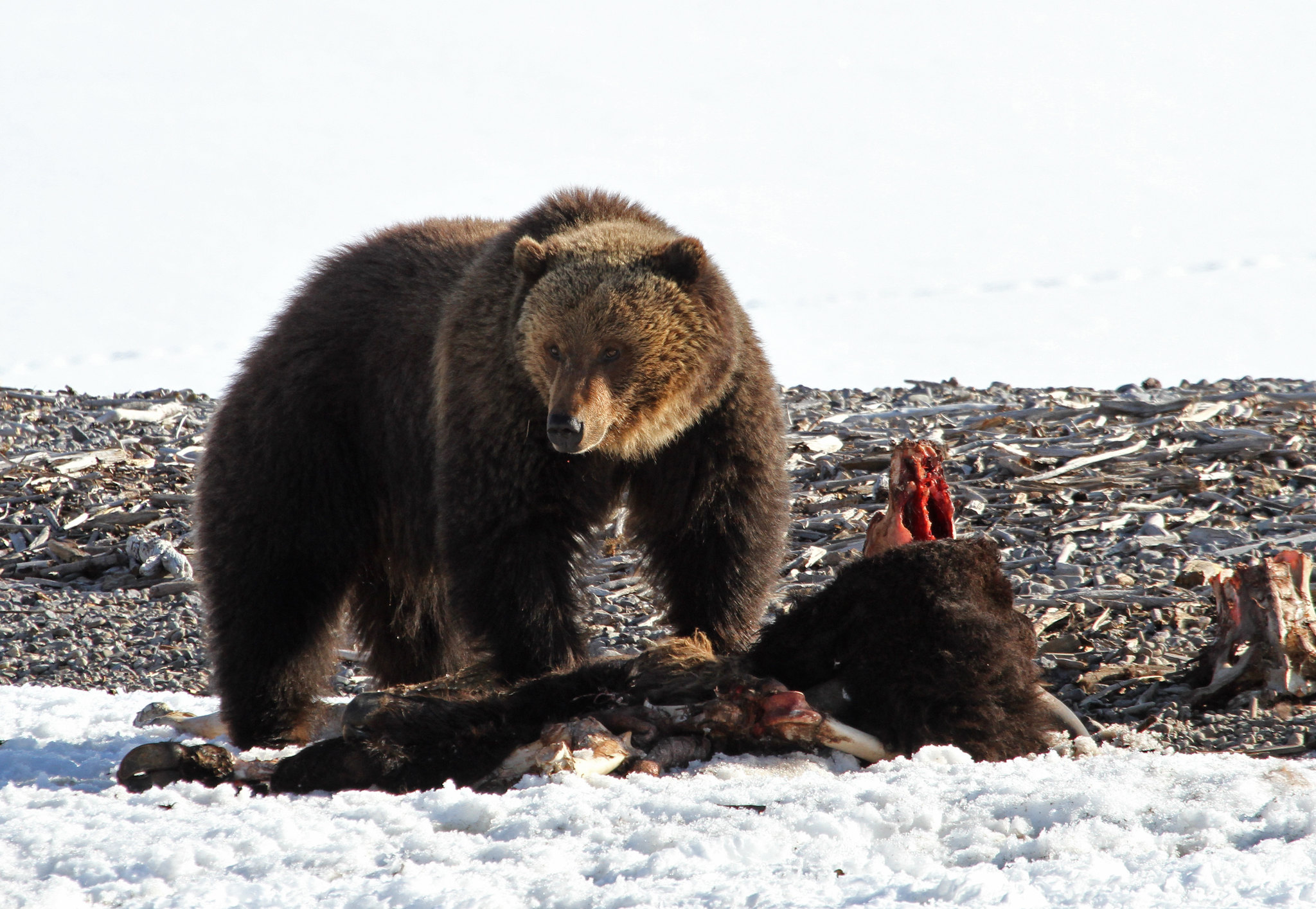
Yellowstone National Park’s first grizzly bear sighting of 2026

On March 9, Yellowstone biologists working in the northern part of the park reported seeing the first grizzly bear of the spring season. The bear was observed in the backcountry scavenging on a bull bison carcass.
The first reported grizzly bear sighting of 2025 occurred on March 14. In 2024, it occurred on March 3, and in 2022 and 2023, March 7.

When bears emerge from hibernation, they look for food and often feed on elk and bison that died over the winter. Bears may react aggressively to encounters with people when feeding on carcasses. Male grizzlies come out of hibernation in early March. Females with cubs emerge in April and early May.

All of Yellowstone is grizzly and black bear country: from the deepest backcountry to the boardwalks and parking lots around Old Faithful.

Bear spray has proven effective in deterring bears defending cubs and food sources. It can also reduce the number of bears killed by people in self-defense. While firearms are allowed in the park, the discharge of a firearm by visitors is a violation of park regulations.


              ************************************************************************************

Check out our online trail guides:
  • My new, improved and expanded edition on the history of hiking is now available on Amazon


Margaret Stevenson – The GOAT

The following an adaptation from my new book, Ramble On: A History of Hiking:

In 1960, Margaret Stevenson took up hiking to relieve severe back pain. Sixteen years later, at the age of 64, she became the first woman to hike every trail in the Great Smoky Mountains. Shortly after her death in 2006, the Tennessee House issued a joint resolution honoring Ms. Stevenson. It read, in part:
WHEREAS, Mrs. Stevenson will be fondly remembered as the first woman to hike all 900 miles of trails in the Great Smoky Mountains, logging 3,000 miles a year for 40 years, more mileage than she put on her car;
In 1997, at the age of 84, she registered her 718th ascent of Mt. LeConte, the third highest peak in the Smokies. This would be her final trip to the top of the 6593-foot mountain. Sitting just below the summit of this legendary mountain is the LeConte Lodge, which can only be accessed by one of five backcountry trails. After her death, Stevenson’s bronzed hiking boots were put on permanent display in the dining room of the lodge. The authors of LeConte Lodge: A Centennial History of a Smoky Mountain Landmark, named Stevenson as one of the “Greatest Of All Times (GOATs) of LeConte.”

You can read more about the pioneers of hiking in Ramble On: A History of Hiking.


Monday, March 9, 2026

The First Female Mountaineers (part 2)

The following an adaptation from my new book, Ramble On: A History of Hiking:

Henriette d'Angeville and Anne Lister are considered to be the first true female mountaineers. Less than a month after Lister’s ascent of Mont Vignemale, discussed yesterday, Henriette d'Angeville would become the second female to stand atop Mont Blanc in France. This ascent was made with great fanfare, both before and after her return from the mountain. Despite the enthusiastic response from the people of Chamonix, Henriette was persuaded to draft a will after several friends and relatives warned her that her endeavor was dangerous, foolish and unladylike. Though she also suffered from a serious bout of altitude sickness while ascending the Grande-Côte, d'Angeville refused help from her guides. After struggling for four hours in a “state of agony,” as reported by Henry Gribble, d'Angeville stood atop Mont Blanc on September 4, 1838, and became the first woman to reach the ice-capped summit without assistance. Upon her return to the valley a cannon was fired, and a celebratory dinner and gala were held in her honor - with Marie Paradis in attendance. This feat inspired other European ladies to take to the mountains in the years and decades that would follow.
While Mont Blanc was d'Angeville’s first major alpine ascent, she continued to climb until the age of 69. The Oldenhorn, a rugged 10,246-foot peak in the Bernese Alps of Switzerland, was her final excursion. Afterwards, d'Angeville famously quipped, “The Oldenhorn is my twenty first Alpine ascent, and will probably be one of the last; for it is wise at my age to drop the alpenstock before the alpenstock drops me.”

You can read more about the pioneers of hiking in Ramble On: A History of Hiking.


Sunday, March 8, 2026

The First Female Mountaineers (part 1)

The following an adaptation from my new book, Ramble On: A History of Hiking:

Anne Lister and Henriette d'Angeville are considered to be the first true female mountaineers. Born in Yorkshire, England in 1791, Lister is widely regarded as "the first modern lesbian." Much of what we know about her comes from her diaries, which she maintained throughout much of her life. It’s estimated that she wrote roughly five million words. Lister is also known for having a strong passion for travel, adventure and rambling. Her first recorded excursion was a trek to the top of 3560-foot Mount Snowdon in Wales in 1822. Her most famous accomplishment, however, was that of becoming the first “amateur” to ascend Mont Vignemale, the highest peak in the French Pyrenees. This ascent was made famous because it quite possibly resulted in the first legal course of action to stem from climbing a mountain.

During a visit to the Pyrenees in 1838, Anne decided that she wanted to become the first “amateur” to stand atop the 10,820-foot mountain. Around that time it was thought that Mont Vignemale was inaccessible from the French side of the border; however, a professional guide by the name of Henri Cazaux discovered a viable route during the previous summer. As a result, Lister hired him to become her guide. While impatiently waiting several days for foul weather to clear out of the region, Lister learned on August 6th that Prince de La Moscowa was planning to climb the mountain later that week, regardless of weather conditions. With assurances from Cazaux that conditions were about to improve, Lister decided to make her attempt on the following day. She, Cazaux, and two other guides reached the summit of Mont Vignemale on August 7th. One week later, however, Anne learned that Cazaux had informed the Prince that she was unsuccessful in her bid, and that he was actually the first amateur to ascend the mountain. Obviously infuriated by this revelation, Anne sought legal remedy to force Cazaux to admit that she was indeed the first amateur to climb the mountain. Lister argued that if she hadn’t reached the summit, then her guide had obviously failed; thus, she had the right to withhold payment for his services. A lawyer from Lourdes agreed with this, and drafted an affidavit attesting to the fact that she was the first “amateur” to reach the summit, which Cazaux sheepishly signed.

You can read more about the pioneers of hiking in Ramble On: A History of Hiking.