Showing posts with label Great Northern Railway. Show all posts

Tuesday, April 14, 2026

What happened to the old Logan Pass Trail?

I recently finished reading Switchback, a book by William Yenne that chronicles his time working as a packer in Glacier National Park and the surrounding national forests during the 1920s and 30s. In the book, he mentioned the Logan Pass Trail a couple of times, which piqued my curiosity as to where the old route tracked, and why it faded from existence.

During the early years of the park, the trail played an important role in the Great Northern Railway’s growing system of trails, which allowed tourists to travel between their network of hotels, chalets and tent camps. The Logan Pass Trail became part of a tour known as the “Triangle Trip,” one of four tourist trails, or circle tours, which we will discuss a little more in-depth tomorrow (link here). Though many visitors hiked these trails on foot, most traveled them on horseback prior to World War II. Louis W. Hill, president of the Great Northern Railway, explained to newspaper reporters that the “lodges would be located only far enough apart so that the man on foot even could make the trip and obtain sleeping accommodations,” and that “hotel accommodations of a more prestigious type or tents for the most modest could also be furnished.”

Construction on the Logan Pass Trail began in 1917, and was completed during the summer of 1918. The 16.4-mile trail, named for William Logan, the first superintendent of Glacier National Park, connected the Going-to-the-Sun Chalets with Granite Park Chalets. In all likelihood, the construction efforts were bankrolled by the Great Northern Railway, who built most of the trails during the early years of the park in order to connect their network of overnight facilities. Construction of the Granite Park Chalets was completed by the railway in 1915, and was already accessible to tourists via the Swiftcurrent Pass Trail, a route that was originally used by Native Americans. By 1915, the Great Northern had also completed construction on the Going-to-the-Sun Chalet complex at Sun Point. The complex, which remained in operation until 1942, included two large dormitories that could sleep up to 200 people, a large dining room, as well as laundry facilities. Until the Going-to-the-Sun Road was completed in 1933, the only way to reach the chalets was by boat or pack horse. The chalets were closed during World War II, fell into disrepair, and were eventually torn down in 1948. However, during their heyday, they were second only to the Many Glacier Hotel in terms of visitor traffic, and as a hub of outdoor activities. To underscore their importance, serious consideration was given at one point for the construction of a hotel on the site on the scale of the Many Glacier Hotel, which would’ve accommodated up to 500 guests.


In a letter to the Director of the National Park Service, dated September 24, 1917, a park civil engineer provided an update on new trail construction efforts within the park during the previous summer. Here are his comments with regards to the Logan Pass Trail:
Logan Pass Trail: This trail, which extends from Granite Park along the west side of the Continental Divide through Logan Pass, thence down Reynolds Creek to a junction with the Plegan Trail, is under construction, about 12 miles of which is practically completed and about 4 miles more will be roughed out so that it can be used for travel. The grading on this trail varies from about 3 ft. in dirt to 6 or 8 ft. in the heavier rock work, quite a good deal of which was encountered. When completed the trail will be about 16 miles long and will be the most scenic trail and the trail of highest average elevation of any in the Park. It will also open to tourist travel the Twin Lakes and Hidden Lake regions which have heretofore been practically inaccessible except to foot tourists that were good climbers.
A snippet in a pamphlet published by the United States Railroad Administration in 1919 provides a slightly more detailed description of the trail one year after its completion:
Leaving Going-to-the-Sun Chalets, this trail branches to the left four miles out on the Piegan Pass trail and strikes up Reynolds Creek, past the shelf glacier which sprinkles its waters on a narrow fertile bench called the Hanging Gardens, on the east side of Mt. Reynolds, to a little plateau between Pollock and Oberlin Mountains. The summit of the pass and the approaches to it are literally covered with wild flowers. From the western slope the trail continues along the Garden Wall—a high, thin, saw-tooth ridge—to Granite Park Chalets.
Below is a section of a park map from 1927 showing the route (you can click on the image to see a slightly larger map). You should note that the red box above St. Mary Lake represents the location of the Going-to-the-Sun Chalets. You may also notice a red line extending up to Logan Pass from the west side of the park – this represents the portion of the Going-to-the-Sun Road that had been completed by that time. It would be another five years before the eastern segment of the road would be completed:


Though this map isn’t as precise as modern maps, the new trail appears to split-off from the Piegan Pass Trail just west of today’s Jackson Glacier Overlook along the Going-to-the-Sun Road, and just east of the confluence of Reynolds Creek and Siyeh Creek. A map from the 1949 park brochure, however, shows a different route. The 1927 map clearly shows the trail ascending towards Logan Pass along Reynolds Creek, south of the present-day Going-to-the-Sun Road. However, the 1949 map shows it tracking north of the road:


It’s possible that the trail was rerouted between those two dates, but seems highly unlikely. Moreover, William Yenne confirms in his book that the trail tracked above the road when he relayed an incident that took place in 1932, “directly above the east side tunnel of the new road”. The photo below, published by the U.S. Railroad Administration in a pamphlet from 1919, also testifies to the trail passing along the steep slopes of Piegan Mountain, well above the east side tunnel, and the Reynolds Creek valley:


As mentioned throughout the pages of View With A Room, Louis W. Hill was very demanding and meticulous on how his chalets and hotels were to be built and designed. These traits obviously carried over to the trail system as well. In a letter dated July 21, 1923, Hill made these interesting, and rather pointed comments to J. R. Eakin, the Superintendent of Glacier National Park:
After a few days' trip in Glacier Park, I feel I should write you very frankly my observations and impressions, I cannot help but be greatly interested in the development of the Park as we have a very large investment there - about $1,500,000 - in the hotels, camps, cost of roads, bridges, etc.

The Logan Pass Trail is not as wide nor in as good condition as when originally constructed. Certainly the two or three years’ maintenance, if properly maintained, would make it a better trail than when originally constructed. The only trail crew I saw consisted of three men on the west side of Logan Pass. The east side of Logan Pass needs cleaning out, which would widen the trail and, of course, the loose rocks would be removed. This is a very inexpensive piece of work. I would also suggest that this being a precipitous country for a trail, it would be in the interest of safety to put up a sign and instruct guides that all parties should arrive at Logan Pass summit before 12:00 o'clock noon and not leave before 1:00 PM. This would give an hour's leeway and permit stragglers to come in and prevent parties meeting and passing on the narrow dangerous portions of the trail. It will always be dangerous to pass horses on some parts of this trail. This should be a simple remedy, particularly if it were understood that guides or tourists who do not observe the regulations - should you put them in – might be asked to leave the Park. This precaution, I am sure, would be appreciated by the tourists as they are all fearful of meeting horses in the narrow places.
The ultimate demise of the Logan Pass Trail came about for several reasons. Chief among them was the completion of the Going-to-the-Sun Road, which allowed visitors to easily drive to Logan Pass, rather than spend a day or more on horseback to reach the higher elevations of the park. Moreover, visitation to the park plummeted during World War II. By 1945, nearly all of the tent camps and chalets had been abandoned, and were ultimately torn down. As result, the National Park Service cancelled the Park Saddle Horse Company concessionaire contract that year due to lack of support. By this time the eastern portion of the trail had become more or less obsolete.

There’s no record online of what eventually became of the Logan Pass Trail. It seems to have simply faded from memory. 1932 was the last year that the park brochure mentioned the Logan Pass Trail by name. The park continued to mention the route through 1939, but the trail was not named. In some cases it was referred to as the Garden Wall Trail, at least the western portion of the trail. The last reference to the “Logan Pass Trail” that I could find was made in a 1945 issue of National Parks Magazine. The last time the trail appeared on a map was in the 1960 park brochure. It appears the trail was at last gone and forgotten with the onset of the new decade.

Although the eastern portion of the trail has long been abandoned, the western leg continues to thrive today, and is now known as the Highline Trail. The first segment of the Highline runs 7.6 miles from Logan Pass to Granite Park Chalet. It’s now connected with the “newer” section of the Highline, which was constructed between 1928 and 1929. This leg travels 14 miles from the chalet to Fifty Mountain, an expansive alpine meadow near the junction of the Highline, Flattop Mountain and Waterton Valley trails.


                *******************************************************************************

Virtually no one went hiking before the 19th century. What occurred that inspired ordinary people to take a walk through the woods for pleasure? Ramble On: A History of Hiking explores the rich history of hiking, and how it evolved into one of the most popular pastimes in the world.


Tuesday, March 24, 2026

The Historic Circle Tours of Glacier National Park

The following is an adaptation from my book, Ramble On: A History of Hiking:

Almost immediately after Glacier was established as a national park, Louis W. Hill, president of the Great Northern Railway, began building a series of hotels, chalets and tent camps throughout the park. The buildings were modeled on traditional Swiss architecture, and were part of Hill's strategy to portray Glacier as the "American Alps" or "America's Switzerland." The accommodations would in-turn help the railway promote tourism to the new national park, while at the same time promote their rail line as the primary mode of travel to the park. This would also allow them to compete against their chief rivals; the Canadian Pacific Railway and the Northern Pacific Railway, who were already transporting tourists to Banff and Yellowstone.


The Belton Chalet in West Glacier, and the Glacier Park Lodge in East Glacier Park were the first two hotels to be constructed by Great Northern. Both acted as gateways from railroad depots to the interior of the park. Between 1910 and 1915, the railway also constructed eight Swiss-style backcountry chalet complexes, each connected by a network of trails. The complexes were strategically located at Two Medicine Lake, Cut Bank, St. Mary, Sun Point, Granite Park, Many Glacier, Gunsight Lake and Sperry Glacier. Tent camps were also established at Red Eagle Lake, Cosley Lake, Fifty Mountain and Goat Haunt. The chalet and tent camps were located roughly 10-18 miles apart. During their prime most of the chalet camps could host between 100 and 150 guests per night. Hill would explain to newspaper reporters that the “lodges would be located only far enough apart so that the man on foot even could make the trip and obtain sleeping accommodations,” and that “hotel accommodations of a more prestigious type or tents for the most modest could also be furnished.”


As construction on the new chalets progressed through the early 1910s, the railway also constructed the trails that would connect each of them by foot or horse travel. Because of a lack of federal funds, the Great Northern Railway assumed financial responsibility for all trail construction during this time period, but was eventually reimbursed as funding became available. Some of the earliest trails developed by the railway included Swiftcurrent Pass, Gunsight Pass, Mt. Henry, Red Gap Pass, Gable Pass, Triple Divide Pass, Piegan Pass, Pitamakan Pass and the St. Mary Lake trails. Many of these early trails were routed along Indian paths, prospector trails or old game trails. Great Northern would continue to improve or construct new trails within the park into the early 1920s. As the network of trails expanded, organized tours by horse concessionaires began to emerge. In 1915, the Park Saddle Horse Company became the sole concessionaire for the park, and began organizing a series of guided tours that utilized the existing network of chalets and trails. This included the North Circle, South Circle and Inside Trail trips, which encompassed roughly 163 miles of trails, each of which is now on the National Register of Historic Places. The company also offered the Logan Pass Triangle Trail trip, which traversed across the heart of the park utilizing routes from the other tours, as well as the now abandoned Logan Pass Trail, which I discussed in detail yesterday. The concessionaire offered a variety of options, from half-day excursions to extended trips lasting up to two weeks. Most of the so-called circle tours, however, lasted between three and five days. During the 1920 season, the company charged roughly $4.00 per person, per day to take one of its saddle-horse tours.


Although there were several variations of each of these trips, depending on the number of days tourists chose, the direction they wanted to take, as well as the evolution of routes over time, these are the routes described on the National Register of Historic Places Registration Form and various park brochures:

The North Circle: Connects Many Glacier with Cosley (aka Crossley) Lake; Cosley Lake with Goathaunt; Goathaunt with Fifty Mountain; Fifty Mountain with Granite Park; Granite Park with Many Glacier.

The South Circle: Connects Lake McDonald Lodge with Sperry Chalets; Sperry Chalets with Sun Point via Gunsight Pass; Sun Point with Many Glacier via Piegan Pass; Many Glacier with Granite Park via Swiftcurrent Pass; Granite Park with Going-to-the-Sun Road at Packer's Roost.

Logan Pass Triangle trip: Three-day trip made as follows: Many Glacier Hotel to Granite Park Chalets via Swiftcurrent Pass, thence along the west side of the Garden Wall through Logan Pass to Going-to-the-Sun Chalets, thence back to Many Glacier Hotel via Glacial Meadows and Piegan Pass. Rate for guide and horses, $12.50 per person. Going-to-the-Sun Chalets is also a point of departure for this trip.

Inside Trail: Guide and horses may be obtained for a five-day trip over the inside trail from Glacier Park Hotel, via Two Medicine Chalets, thence via Mount Morgan Pass (now known as Pitamakan Pass) to Cut Bank Chalets, thence via Triple Divide, Red Eagle Lake, to St. Mary Chalets, thence via boat across St. Mary Lake to Going-to-the-Sun Chalets, thence via Piegan Pass to Many Glacier Hotel, at the rate of $18 for each person, including boat fare, if five or more make the trip. This trip may be made in either direction.


The park visitors that took these tours were “guided by ‘cowboys,’ lunched near glacial lakes and then dined in comfort on Chinese linen and blue willow china”. Park rules dictated that the Park Saddle Horse Company had to furnish at least one guide for each ten tourists on a trip. Parties could reach as large as 180 people and 200 horses. It’s estimated that the concessionaire used more than 1000 horses during its peak, with at least one source estimating as many as 1500 head of horses. The 1922 park brochure bragged that there were "more saddle horses used in Glacier than in any other similar recreational area in the world". From everything I’ve read that record has never been surpassed.

The saddle-horse tours were the dominant method of seeing the park until the Going-to-the-Sun Road was completed in 1933. Although the tours continued for another ten seasons, they came to a permanent end after the 1942 season when America became fully involved in World War II.

Ramble On chronicles the history of the first hikers, trails, and hiking clubs, as well as the evolution of hiking gear and apparel. This broad-based book on hiking history is available on Amazon.


Other excerpts from Ramble On: A History of Hiking:

* The Etymology of Hiking

* How did hiking become so popular across the globe?

* Women’s Hiking Attire During The Victorian Era

* The Evolution of Hiking Boots


                *******************************************************************************

Glacier National Park preserves more than a million acres of some of the most spectacular scenery on Earth. With more than 740 miles of trails meandering throughout this vast park, how will you find and choose the most scenic and rewarding hikes?

Exploring Glacier National Park takes all the guesswork out by focusing on the most amazing hikes, and provides you with handpicked recommendations that will allow you to make the most of your trip to Glacier:


Monday, April 29, 2024

Dr. Lyman B. Sperry: Early Trail Builder

In the heart of Glacier National Park is the 216-acre Sperry Glacier. It's named after Dr. Lyman B. Sperry of Oberlin College, who scouted for "scenic attractions" on behalf of the Great Northern Railway in an effort to expand tourism opportunities in the region. In June of 1895, while exploring the basin above Lake McDonald, Sperry saw and heard multiple avalanches roaring down the mountains that surround what is now known as Avalanche Lake, and agreed with those in his party, "that Avalanche Basin would be a most appropriate name for the place."

On a return trip later that summer, Sperry would discover the glacier that now bears his name. Here's a photo of the Sperry Party on Sperry Glacier:
Several years later, the college professor would oversee construction of a trail that led from the head of Lake McDonald to Sperry Glacier. Dr. Sperry's trail, constructed in 1902 and 1903 with the help of 15 students from the University of Minnesota, was likely the first organized trail-building effort in the future park. Sperry's motivation for building the trail came from the notion that by providing access to the most beautiful parts of Glacier's backcountry, more people would have the opportunity to see the wonders of the area, and thus increase the probability of preserving it as a national park.

Now known as the Gunsight Pass Trail, Dr. Sperry's original trail still leads to the glacier that bears his name, as well as the historic Sperry Chalet. At an elevation of more than 6550 feet, Sperry Chalet sits high atop a rock ledge that offers visitors commanding views of majestic mountain peaks, waterfalls and the Lake McDonald valley. Now listed as an Historic Landmark, the Sperry Chalet dining chalet was built by the Great Northern Railway in 1913, while the original dormitory was completed during the following year. For those visiting Sperry on a day hike, you may want to note that the dining room is open to the public from 11:30 a.m. to 5:00 p.m. each day.

In my book on the history of hiking, I discuss trail development in Glacier in far more detail, including the crucial role the Great Northern Railway played during the early years of the park.

Here's a hiking party on Sperry Glacier in the 1920s:
Here's a photo from the Milwaukee Public Museum with the title, "Crevass in Sperry Glacier into which a lady fell 45 feet but was not serious hurt":
There's a description of a rescue of a woman who fell into a crevasse on Sperry Glacier that was published in Early Days in the Forest Service. The account, written by Frank F. Liebig, the ranger who made the rescue in 1907, doesn't really match the photo in many respects, so I'm not sure if the photo is from the same incident. On the other hand, I couldn't find any other incidents from this period. Either way, his description of the rescue he was involved with is pretty dramatic.


                *******************************************************************************

Virtually no one went hiking before the 19th century. What occurred that inspired ordinary people to take a walk through the woods for pleasure? Ramble On: A History of Hiking explores the rich history of hiking, and how it evolved into one of the most popular pastimes in the world.


Monday, April 8, 2024

Cut Bank Chalets

The Cut Bank Chalets on the east side of Glacier National Park were one of nine backcountry chalet complexes built by the Great Northern Railway during the second decade of the 20th Century. Located near the present day Cut Bank Trailhead, the railway constructed four structures between 1911 and 1912, including an 18x80 foot dining hall/kitchen, two single room cabins, and a two-story six-room cabin with a lounge area. The chalets officially opened in 1913, and were able to accommodate up to 42 guests during its heyday. As a result of its location near the North Fork Cut Bank Creek, the rustic lodge became a very popular destination for fishermen.

In 1917, the NPS constructed a ranger station near the chalet. This is the only building from that era that still remains in the Cut Bank valley. Due to declining business, the lodge closed in 1933. By 1949 the structures were regarded as "beyond repair" and an "eyesore," and were dismantled by the park.

The historic photo below was taken by T.J. Hileman around 1925. Above the main building is Bad Marriage Mountain:
Here's a close-up photo of the main building, taken by George A. Grant in 1932:
Though the chalets are long gone, the somewhat remote Cut Bank valley still offers hikers outstanding hiking opportunities, including Medicine Grizzly Lake and Triple Divide Pass.


                *******************************************************************************

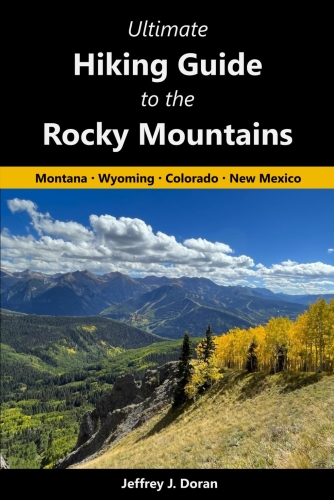
From Montana to New Mexico, the American Rockies stretch for more than a thousand miles. Within this spectacular mountain range are thousands of miles of hiking trails. With such an overwhelming number of options, how will you find and choose the most scenic and rewarding hikes?

Ultimate Hiking Guide to the Rocky Mountains takes all the guesswork out by focusing on some of the most amazing hikes across this range, and provides you with a handpicked list of options that will allow you to make the most of your trips in the Rockies:


Tuesday, December 4, 2018

Why Were Locomotive Bells Placed Atop Mountain Passes in Glacier National Park?

The following is a short excerpt from my book, Ramble On: A History of Hiking:

Did you know that locomotive bells were once placed atop four mountain passes in Glacier National Park? Why were they placed there, who pushed the idea, and what became of them?

To further enhance the Swiss experience for park visitors, W. R. Mills, an advertising agent for the Great Northern Railway, and H. A. Noble, manager of the Glacier Park Hotel Company, requested permission from the park in 1925 to place locomotive bells atop the summits of several passes. According to Donald H. Robinson's administrative history of Glacier National Park, the request originated from on an old Swiss custom of placing bells on mountain tops and passes so that hikers and horseback riders could ring loud bells in the mountains, and signal to people in the valleys that they had reached their destination. In September of 1926, the request was finally approved to place bells at Swiftcurrent Pass, Siyeh Pass and Piegan Pass. Three years later, a fourth bell was added at Scenic Point in Two Medicine. Visitors continued ringing the bells until the fall of 1943, at which point they were removed by the hotel company and donated to a World War II scrap metal drive.


Although the bells were removed, and most of the backcountry chalets were razed or destroyed, much of the Great Northern Railway's presence in Glacier still remains. In addition to most of the trails, the Belton Chalet, Glacier Park Hotel, Many Glacier Hotel, Sperry Chalet and the Granite Park Chalets are all still used by park visitors today.

If you would like to learn more about this fascinating time period during the early years of Glacier National Park, as well as many other stories associated with the history of hiking, you can read them in my book, Ramble On: A History of Hiking, now available on Amazon


                *******************************************************************************

Virtually no one went hiking before the 19th century. What occurred that inspired ordinary people to take a walk through the woods for pleasure? Ramble On: A History of Hiking explores the rich history of hiking, and how it evolved into one of the most popular pastimes in the world.


Monday, April 7, 2014

Sperry and Granite Park Chalets Celebrate 100 Years

This year marks the 100th anniversary of the Sperry and Granite Park Chalets. Both backcountry chalets were built in 1914 during a period when the Great Northern Railway was promoting Glacier National Park under the "See America First" campaign.

During the early 1900s some Americans were becoming alarmed over the increased spending of American dollars on European travel. While discussing Glacier one day, Senator "Pitchfork Ben" Tillman of South Carolina stated: "It is very ridiculous to me to see the amount of money spent by Americans to see the scenery of Europe without having first seen what we have at home." This concern provided one of the motivations for creating a national park at Glacier. Having an "American Alps," or a "Switzerland of the United States," such as Glacier, allowed America to compete against Canadian and European resorts and tourist attractions.

The Great Northern Railway played an extremely important role in the establishment of the national park during this time period as well. The Great Northern had a rail line running along the southern edge of Glacier, and saw the establishment of a national park as a way of increasing passengers on their trains, while also increasing their revenues.

So it was against this backdrop that the president of the Great Northern Railway, Louis W. Hill, began building a number of hotels and chalets throughout the park in the 1910s as a way of promoting tourism. These buildings were modeled on Swiss architecture as part of Hill's plan to portray Glacier as the "American Alps" or "America's Switzerland". Included in this project was a network of 9 European-style chalet complexes. Thus, leaving from one of Hill's luxury lodges, guests could hike or ride to one his rustic chalets in less than a day.

The chalets, built between 1910 and 1915, included Sperry, Granite Park, Cut Bank, Goat Haunt, Going-to-the-Sun (Sun Point), St. Mary, Gunsight Lake, Many Glacier, and one of the Two-Medicine Chalets (the other was converted into a store, which is still in use today). In their prime, several of the Chalets would host 100 to 150 guests a night.

Today, only Sperry and Granite Park remain. Both owe their survival to the use of native stone as their primary construction material. The masonry of these chalets made it possible to withstand Montana’s brutal winters. In contrast, the wooden structures of the other chalets deteriorated so badly that many had to be razed during the late 1940s.

Sperry Chalet:

Perched at an elevation of more than 6500 feet, Sperry Chalet sits high on a rock ledge that offers visitors commanding views of majestic mountain peaks, waterfalls, as well as Lake McDonald in the valley far below. The two main buildings at Sperry consist of a two story hotel and a kitchen/dining room. There’s also a modern composting restroom facility located between the two buildings.

The hotel, more commonly referred to as a "dormitory", was designed by Kirtland K. Cutter and Karl G. Malmgren, and contains 23 guest rooms. In 1992 the chalet was forced to close due to safety and environmental concerns. Fortunately it was restored and reopened again in 1999.

The only way to reach this backcountry chalet is by trail. Most people will hike the 6.1-mile Sperry Trail to the chalet. Reservations are required for overnight stays, but lunch and great views are offered to day hikers.

Granite Park Chalet:

Designed by architect Samuel L. Bartlett, the Granite Park Chalet consists of a dormitory and a "chalet" used as a dining hall, resident living quarters, and guest rooms. Compared to its sister to the south, the Granite Park Chalet is much more basic, and is essentially a simple hiker's hostel with virtually no amenities. It has 12 guest rooms, each with 2 to 6 bunks. There’s no electricity, but the common-area kitchen has a propane stove. The chalet rests just below Swiftcurrent Pass along the edge of a sub-alpine meadow that offers commanding views of Heavens Peak and the McDonald Valley.

As a result of the difficulty in maintaining the chalet, the Great Northern Railway sold the chalet to the National Park Service in 1954 for the princely sum of just $1.00. As with Sperry, Granite Park was forced to close as a result of safety and environmental concerns, but was reopened in 1996.

There are four trails that lead to the Granite Park Chalet. The Highline Trail, at 7.6 miles, is by far the most popular option. At just 4.2 miles, the Granite Park Trail from “The Loop” on the Going-to-the-Sun Road is the shortest route, but climbs 2300 feet. The Swiftcurrent Pass Trail out of Many Glacier is 7.6 miles in length and climbs 2400 feet. The fourth option is a very long trek from Goat Haunt near the Canadian border.


Additional Information on the History of Glacier's Chalets:

For more historical perspective on this subject, please check out Glacier's Historic Hotels And Chalets, which traces the creation and use of the Great Northern Railway’s hotels and chalet colonies in Glacier National Park, and includes many historic photographs.


Jeff
Hiking in Glacier.com

Wednesday, September 25, 2013

What happened to the other 7 backcountry chalets in Glacier National Park?

Did you know that there were a total of nine backcountry chalets in Glacier National Park at one point? You're probably already aware of Sperry and Granite Park Chalets. So, what ever happened to the other seven chalets?

In the early 1900s, some Americans were becoming alarmed over the increased spending of American dollars on European travel. While discussing Glacier one day, Senator "Pitchfork Ben" Tillman of South Carolina stated: "It is very ridiculous to me to see the amount of money spent by Americans to see the scenery of Europe without having first seen what we have at home." This concern provided one of the motivations for creating a national park at Glacier. Having an "American Alps," or a "Switzerland of the United States," such as Glacier, allowed America to compete against Canadian and European resorts and tourist attractions.

The Great Northern Railway also played an extremely important role in the establishment of Glacier as a national park during this time period. The Great Northern had constructed a rail line along the southern edge of Glacier, and saw the establishment of a national park as a way of increasing passengers on their trains, which in-turn would help to increase their revenues.

So, it was against this backdrop that the president of the Great Northern Railway, Louis W. Hill, began building a number of hotels and chalets throughout the park in the 1910s as a way of promoting tourism. These buildings were modeled on Swiss architecture as part of Hill's plan to portray Glacier as the "American Alps" or "America's Switzerland." Included in this project was a network of nine European-style chalet complexes. Thus, leaving from one of Hill's luxury lodges in the frontcountry, guests could hike or ride to one these rustic chalets in less than a day.

Two Medicine Chalet:
The chalets, built between 1910 and 1915, included Sperry, Granite Park, Cut Bank, Belton, Going-to-the-Sun (Sun Point), St. Mary, Gunsight Lake, Many Glacier, and one of the Two-Medicine Chalets (the other was converted into a store, which is still in use today). In their prime, several of the Chalets would host as many as 100 to 150 guests per night.

The Sun Chalets:
Today, only Sperry and Granite Park remain. Both owe their survival to the use of native stone as their primary construction material. The masonry of these chalets made it possible to withstand Montana’s brutal winters. In contrast, the wooden structures of the other chalets deteriorated so badly that many had to be razed during the late 1940s.

Granite Park Chalet:
The first chalet to meet its demise was Gunsight Lake when it was destroyed by an avalanche in 1916. The Many Glacier Chalets burned down during a massive forest fire in 1936. During WWII, the remainder of the chalets were closed. The lack of use during the war years forced a reassessment of the facilities, and by 1944 park officials agreed that the St. Mary Chalet was no longer necessary, and was subsequently destroyed. Similarly, the chalets at Cut Bank and Sun Point were regarded as "beyond repair" and an "eyesore," and were destroyed by 1949. Finally, the structure used for lodging at Two-Medicine was razed and burned in 1956.

St. Mary Chalet:


Cut Bank Chalet:
It’s a shame that America had to lose these historic structures. Too bad the Great Northern Railway didn’t have the foresight to build more of the chalets out of native stone. Modern day hikers would have even more overnight destinations from which to consider - without having to rough it!.


                *******************************************************************************

Virtually no one went hiking before the 19th century. What occurred that inspired ordinary people to take a walk through the woods for pleasure? Ramble On: A History of Hiking explores the rich history of hiking, and how it evolved into one of the most popular pastimes in the world.


Saturday, September 7, 2013

Glacier National Park: Land of Shining Mountains (Part 1)

From the Glacier archives is this black and white silent travelogue, produced by the Great Northern Railway circa 1930, before the Going-to-the-Sun Road was completed. You may notice some familiar views in this film. Although the film shows early visitors interacting with wildlife, visitors today should not feed or approach wildlife. I'll be publishing part 2 of this film on Wednesday:


                *******************************************************************************

Virtually no one went hiking before the 19th century. What occurred that inspired ordinary people to take a walk through the woods for pleasure? Ramble On: A History of Hiking explores the rich history of hiking, and how it evolved into one of the most popular pastimes in the world.


Tuesday, November 29, 2011

What happened to the other 7 backcountry chalets in Glacier?

Did you know that there were a total of nine backcountry chalets in Glacier National Park at one point? So what happened to the other seven?

In the early 1900s some Americans were becoming alarmed over the increased spending of American dollars on European travel. While discussing Glacier one day, Senator "Pitchfork Ben" Tillman of South Carolina stated: "It is very ridiculous to me to see the amount of money spent by Americans to see the scenery of Europe without having first seen what we have at home." This concern provided one of the motivations for creating a national park at Glacier. Having an "American Alps," or a "Switzerland of the United States," such as Glacier, allowed America to compete against Canadian and European resorts and tourist attractions.

The Great Northern Railway played an extremely important role in the establishment of a national park during this time period as well. The Great Northern had a rail line running along the southern edge of Glacier, and saw the establishment of a national park as a way of increasing passengers on their trains, while also increasing their revenues.

So it was against this backdrop that the president of the Great Northern Railway, Louis W. Hill, began building a number of hotels and chalets throughout the park in the 1910s as a way of promoting tourism. These buildings were modeled on Swiss architecture as part of Hill's plan to portray Glacier as the "American Alps" or "America's Switzerland". Included in this project was a network of 9 European-style chalet complexes. Thus, leaving from one of Hill's luxury lodges, guests could hike or ride to one these rustic chalets in less than a day.

The chalets, built between 1910 and 1915, included Sperry, Granite Park, Cut Bank, Goat Haunt, Going-to-the-Sun (Sun Point), St. Mary, Gunsight Lake, Many Glacier, and one of the Two-Medicine Chalets (the other was converted into a store, which is still in use today). In their prime, several of the Chalets would host 100 to 150 guests a night.

Today, only Sperry and Granite Park remain. Both owe their survival to the use of native stone as their primary construction material. The masonry of these chalets made it possible to withstand Montana’s brutal winters. In contrast, the wooden structures of the other chalets deteriorated so badly that many had to be razed during the late 1940s.

St. Mary Chalet:

The first chalet to meet its demise was Gunsight Lake when it was destroyed by an avalanche in 1916. The Many Glacier Chalets burned down during a massive forest fire in 1936. During WWII the remainder of the chalets were closed. The lack of use during the war years forced a reassessment of the facilities, and by 1944 park officials agreed that the St. Mary Chalet was no longer necessary and was subsequently destroyed. Similarly, the chalets at Cut Bank and Sun Point were regarded as "beyond repair" and an "eyesore" and were destroyed by 1949. Finally, the structure used for lodging at Two-Medicine was razed and burned in 1956.

It’s a shame that America had to lose these historic structures. Too bad the Great Northern Railway didn’t have the foresight to build more of the chalets out of native stone. Modern day hikers would have even more overnight destinations from which to consider.

For more historical perspective on this subject, check out Glacier's Historic Hotels And Chalets, which traces the creation and use of the Great Northern Railway’s hotels and chalet colonies in Glacier National Park, and includes many old photographs.


                *******************************************************************************

Virtually no one went hiking before the 19th century. What occurred that inspired ordinary people to take a walk through the woods for pleasure? Ramble On: A History of Hiking explores the rich history of hiking, and how it evolved into one of the most popular pastimes in the world.