The Flathead National Forest is hosting a free avalanche awareness and safety training program beginning Tuesday, January 3. The program, focused for down-hill and cross-country skiers, snowboarders, snowshoe enthusiasts and mountaineers, will consist of four evening lectures and two all-day field sessions.
The evening lectures will be Tuesdays and Thursdays January 3, 5, 10 and 12 at the Flathead National Forest Office in Northwest Kalispell, 650 Wolfpack Way, 6:30 – 9:30pm (located south of Glacier High School). The Saturday field sessions will be January 7 and 14.
Flathead National Forest Avalanche Specialist Stan Bones said, “The program will include information about avalanche terrain, mountain weather and snowpack, stability evaluation and decision making, and avalanche rescue.” Bones encourages participants to attend all sessions to gain maximum benefit. Registration is not required for the workshop but participants are encouraged to contact the Flathead National Forest 758-5284 or visit www.fs.usda.gov/flathead for more information.
REMINDER:
The Flathead National Forest issues avalanche advisories for Northwest Montana throughout the winter. Advisories are issued once a week, on Friday mornings until the last week of December, when they are issued Tuesday and Friday mornings (as weather conditions warrant) until April. Advisories include information about snowpack conditions, weather forecasts, and hazard evaluations.
Advisories are posted on the Flathead National Forest website, and on the Glacier Country Avalanche Center website, www.glacieravalanche.org.
The advisory can also be accessed by calling 406-257-8702. Anyone traveling in the backcountry will always need to make their own time and site specific avalanche hazard evaluations.
Jeff
Hiking in Glacier.com

Showing posts with label mountaineers. Show all posts
Showing posts with label mountaineers. Show all posts
Friday, December 23, 2011

Thursday, September 22, 2011
The Rest Step
The "Rest Step" is a technique used by mountaineers to slow their cadence, rest their muscles, and preserve their energy while hiking on steep terrain at high altitudes. Essentially, the “rest step” takes pressure and strain off your muscles and transfers it to your bone structure.
Although it’s mainly useful on snow, or on climbs at elevation where endurance is important, it can be employed on any trail with steep slopes. It’s worked quite well for me on many trails in Glacier, Colorado and the Grand Tetons in recent years.
 The tool is most effective on slopes that gain - say - more than 800 feet per mile.
Here’s how it works:
As you step forward on a climb, lock your rear knee and keep all of your weight on that rear leg. As you’re swinging your other leg forward, relax the muscles in that leg. Once your forward foot comes to rest on the ground, keep it relaxed so that there’s no weight on it. You can stop in that position for as long as you need to. When you're ready to take the next step, shift your weight to the front foot, step forward with the other and lock the rear knee again, and repeat the entire process.
The locked rear knee provides support for your weight without requiring help from the leg muscle. That means your leg, hip, and back muscles get a rest, if only for a short moment. Stay paused in that position for however long it takes to avoid running out of breath.
In this short video Ward Luthi from Walking The World demonstrates how this technique is put into action on the trail:
A mountain climber in the Himalayas may stay motionless between steps for 10 seconds or more. At lower altitudes, you might only need a half-second pause. The key is to get into a steady rhythm of doing the same thing for each step you take. You can adjust the cadence and the length of your stride according to the steepness of the terrain.
Continuous movement is a great strain on your muscles. Moreover, stopping and starting, slowing down and speeding up, wastes energy. The key to preserving your energy for the long haul is to be the tortoise, rather than the hare.
You can quickly get an idea of how this works by practicing on your steps at home. The benefits are especially clear if you can try it after a long hike, run or bike ride when your leg muscles are already tired. Go up the steps as you normally do and you’ll probably feel a little bit of a burn in your quadriceps. Now, try the rest step and notice how the burn is substantially reduced.
*******************************************************************************
From Montana to New Mexico, the American Rockies stretch for more than a thousand miles. Within this spectacular mountain range are thousands of miles of hiking trails. With such an overwhelming number of options, how will you find and choose the most scenic and rewarding hikes?
Ultimate Hiking Guide to the Rocky Mountains takes all the guesswork out by focusing on some of the most amazing hikes across this range, and provides you with a handpicked list of options that will allow you to make the most of your trips in the Rockies: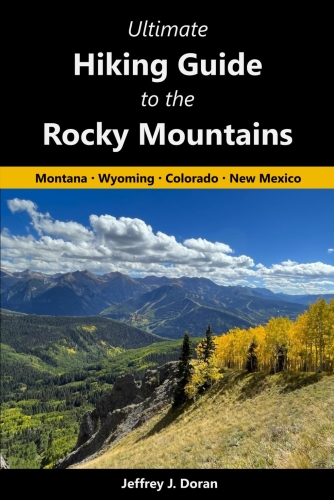
Although it’s mainly useful on snow, or on climbs at elevation where endurance is important, it can be employed on any trail with steep slopes. It’s worked quite well for me on many trails in Glacier, Colorado and the Grand Tetons in recent years.
Here’s how it works:
As you step forward on a climb, lock your rear knee and keep all of your weight on that rear leg. As you’re swinging your other leg forward, relax the muscles in that leg. Once your forward foot comes to rest on the ground, keep it relaxed so that there’s no weight on it. You can stop in that position for as long as you need to. When you're ready to take the next step, shift your weight to the front foot, step forward with the other and lock the rear knee again, and repeat the entire process.
The locked rear knee provides support for your weight without requiring help from the leg muscle. That means your leg, hip, and back muscles get a rest, if only for a short moment. Stay paused in that position for however long it takes to avoid running out of breath.
In this short video Ward Luthi from Walking The World demonstrates how this technique is put into action on the trail:
A mountain climber in the Himalayas may stay motionless between steps for 10 seconds or more. At lower altitudes, you might only need a half-second pause. The key is to get into a steady rhythm of doing the same thing for each step you take. You can adjust the cadence and the length of your stride according to the steepness of the terrain.
Continuous movement is a great strain on your muscles. Moreover, stopping and starting, slowing down and speeding up, wastes energy. The key to preserving your energy for the long haul is to be the tortoise, rather than the hare.
You can quickly get an idea of how this works by practicing on your steps at home. The benefits are especially clear if you can try it after a long hike, run or bike ride when your leg muscles are already tired. Go up the steps as you normally do and you’ll probably feel a little bit of a burn in your quadriceps. Now, try the rest step and notice how the burn is substantially reduced.
*******************************************************************************
From Montana to New Mexico, the American Rockies stretch for more than a thousand miles. Within this spectacular mountain range are thousands of miles of hiking trails. With such an overwhelming number of options, how will you find and choose the most scenic and rewarding hikes?
Ultimate Hiking Guide to the Rocky Mountains takes all the guesswork out by focusing on some of the most amazing hikes across this range, and provides you with a handpicked list of options that will allow you to make the most of your trips in the Rockies:
Subscribe to:
Posts (Atom)