The Department of the Interior today announced the purchase from the State of Wyoming and permanent protection of the 640-acre Kelly parcel, a picturesque landscape known for mountain views and world-class wildlife habitat within Grand Teton National Park.
The parcel, which was state school trust land, had been the largest remaining piece of unprotected land within the boundaries of Grand Teton National Park. The permanent conservation of this square mile maintains essential connectivity for wildlife in the southern Greater Yellowstone Ecosystem—one of the last remaining, nearly intact temperate ecosystems on the planet.
“Today marks an incredible milestone, decades in the making, to permanently protect an essential wildlife migration corridor and treasured landscape within Grand Teton National Park,” said Secretary of the Interior Deb Haaland. “This will benefit our public lands and Wyoming’s public school students for generations to come.”
In 2023, more than 10,000 people from across Wyoming and the United States participated in a public comment process related to the potential sale of the Kelly parcel, overwhelmingly supporting its conservation for wildlife, public enjoyment, and strengthening Wyoming’s economy. In 2023, visitors to Grand Teton National Park contributed $936 million and supported 9,370 jobs in gateway economies.
The $100 million sale to preserve the Kelly parcel was made possible through an Interior Department and National Park Service (NPS) public-private partnership with the Grand Teton National Park Foundation and additional support from the National Park Foundation. The Department invested $62.4 million from the Land and Water Conservation Fund (LWCF) paired with $37.6 million in private donations raised by Grand Teton National Park Foundation. All $100 million from the sale will directly benefit Wyoming’s public education system.
At no cost to taxpayers, the LWCF, which was created by Congress in 1964 and is administered by the NPS, supports increased public access to and protection for federal public lands and waters, and provides grants to state governments for the acquisition and development of public parks and other outdoor recreation sites. LWCF was fully funded by the Great American Outdoors Act.
Located within a key migration corridor for pronghorn, elk, and mule deer, the Kelly parcel provides critical wildlife habitat and extraordinary open space. Grand Teton National Park anchors this unique landscape, connecting Yellowstone National Park with the Bridger-Teton and Caribou-Targhee national forests, including the Upper Green River Valley and the Wind River, Gros Ventre, and Wyoming Range mountains. The parcel is the starting point for the Path of the Pronghorn—the longest land migration in the lower 48 states—and is a critical link to mule deer migration corridors that stretch to public, private and Tribal lands hundreds of miles away.
Today’s closing on the Kelly parcel completes an effort that spanned decades to exchange, trade or sell the state-owned school trust land within Grand Teton National Park. A Wyoming constitutional mandate requires that school trust lands, created at statehood in 1890, must generate income for the common school trust. Since the late 1990s, Wyoming’s congressional delegation, governor and state legislature have worked to resolve this inholding challenge. The late U.S. Senator Craig Thomas passed legislation in 2003 to authorize exchanges, sales or trades that would compensate the State of Wyoming for the Grand Teton school section inholdings. The second to last school section in the park, known as Antelope Flats, was purchased by the NPS in 2016 for $46 million, which was made possible by $23 million in philanthropic support raised by Grand Teton National Park Foundation and the National Park Foundation that matched $23 million from the LWCF.

Monday, December 30, 2024

Friday, December 27, 2024
Montana First Day Hikes 2025
Kick off the New Year with a First Day Hike at a state park near you. On Jan. 1, Montana State Parks will host First Day Hikes across the state. Being immersed in nature is a great way to improve your mental health and physical wellbeing. These fun and informative hikes are open to all ages and are family friendly.
Hikers should wear weather-appropriate clothing, bring a water bottle and ice cleats or snowshoes if the trail conditions are snowy or icy. First Day Hike participants are encouraged to share their adventures on social media with #FirstDayHikes. For more information, visit https://fwp.mt.gov/stateparks/first-day-hikes. Out-of-state vehicles are subject to an $8 entrance fee.
First Day Hikes is an annual, nationwide special event co-sponsored by America's State Parks, which originated more than 26 years ago at the Blue Hills Reservation – a state park in Milton, Mass. All 50 states will be participating in the annual national event that encourages everyone to celebrate the New Year with guided outdoor exploration.
************************************************************************************
Check out our online trail guides:
Hikers should wear weather-appropriate clothing, bring a water bottle and ice cleats or snowshoes if the trail conditions are snowy or icy. First Day Hike participants are encouraged to share their adventures on social media with #FirstDayHikes. For more information, visit https://fwp.mt.gov/stateparks/first-day-hikes. Out-of-state vehicles are subject to an $8 entrance fee.
First Day Hikes is an annual, nationwide special event co-sponsored by America's State Parks, which originated more than 26 years ago at the Blue Hills Reservation – a state park in Milton, Mass. All 50 states will be participating in the annual national event that encourages everyone to celebrate the New Year with guided outdoor exploration.
************************************************************************************
Check out our online trail guides:
- Glacier National Park: HikinginGlacier.com
- Grand Teton National Park: TetonHikingTrails.com
- Rocky Mountain National Park: RockyMountainHikingTrails.com
Thursday, December 26, 2024
Wyoming First Day Hikes 2025
Wyoming State Parks, Historic Sites, and Trails is pleased to announce the 14th consecutive year of its popular First Day Hikes on January 1, 2025.
First Day Hikes are part of a nationwide initiative led by America’s State Parks to encourage people to get outside and enjoy the great outdoors. On New Year’s Day, people of all ages can kick off the New Year out of doors with access to hundreds of free guided hikes organized in all fifty states.
These events will be held at 18 Wyoming State Park and Historic Site locations statewide. Hikes are free and open to the public; all day use fees will be waived on January 1 as part of this initiative.
Once again, participants at each site will also have the chance to win a 2025 Annual Day-Use Certificate and enter a statewide Grand Prize drawing for participating.
Park staff and volunteers will lead the hikes, ranging from 1 to 3 miles. Details about hiking locations, difficulty, length, and terrain can be found here.
Participants are encouraged to “know before you go” and to prepare for winter weather conditions, including dressing appropriately. Hot drinks and refreshments will be provided at most locations, however, participants are also encouraged to bring their own water and snacks.
First Day Hikes are part of a nationwide initiative led by America’s State Parks to encourage people to get outside and enjoy the great outdoors. On New Year’s Day, people of all ages can kick off the New Year out of doors with access to hundreds of free guided hikes organized in all fifty states.
These events will be held at 18 Wyoming State Park and Historic Site locations statewide. Hikes are free and open to the public; all day use fees will be waived on January 1 as part of this initiative.
Once again, participants at each site will also have the chance to win a 2025 Annual Day-Use Certificate and enter a statewide Grand Prize drawing for participating.
Park staff and volunteers will lead the hikes, ranging from 1 to 3 miles. Details about hiking locations, difficulty, length, and terrain can be found here.
Participants are encouraged to “know before you go” and to prepare for winter weather conditions, including dressing appropriately. Hot drinks and refreshments will be provided at most locations, however, participants are also encouraged to bring their own water and snacks.
Monday, December 23, 2024
Sperry & Granite Park Chalets announce season opening details
The owners of the Sperry & Granite Park Chalets just announced their dates for the season and when they'll begin accepting reservations:
************************************************************************************
Check out our online trail guides:
The details for the 2025 season are now in hand, what everyone wants to know is:Wow - I just noticed that Sperry is getting quite expensive! A couple can now expect to pay $517 per night!! I understand, it's basic supply and demand. But many national parks are quickly moving out of the budgets of middle Americans.
We begin accepting reservations on January 13, 2025, 8:00am Mountain time zone.
Sperry Chalet, open July 11 through September 12th.
Granite Park Chalet, open June 30 through September 12th.
Details of the 2025 fares are on the chalet websites. We expect to have the summer workshop schedule available shortly as well.
Merry Christmas and Happy New Year.
************************************************************************************
Check out our online trail guides:
- Glacier National Park: HikinginGlacier.com
- Grand Teton National Park: TetonHikingTrails.com
- Rocky Mountain National Park: RockyMountainHikingTrails.com
Friday, December 20, 2024
Bears translocated to Yellowstone ecosystem exploring new territory, map shows
The lines on the map look like the doodling of a toddler. The pink line makes big loops that sometimes overlap. The green line is wound so tightly, it just looks like a big blob. Though they sometimes get close to each other, they seldom intersect.
The lines show the movements of the female grizzly bear (pink) and male grizzly bear (green) that were relocated from the Northern Continental Divide Ecosystem (NCDE) to the Greater Yellowstone Ecosystem (GYE) this past summer. Both ecosystems have populations of grizzly bears that have surpassed recovery goals. However, the translocation effort was designed to help increase the genetic diversity of the GYE population, which has been isolated from nearby populations for many years. It’s an effort that may be repeated in the future, depending on how close the two populations eventually grow.
“This just jump starts what very likely will also happen naturally,” said Ken McDonald, head of Montana Fish, Wildlife & Parks’ Wildlife Division.
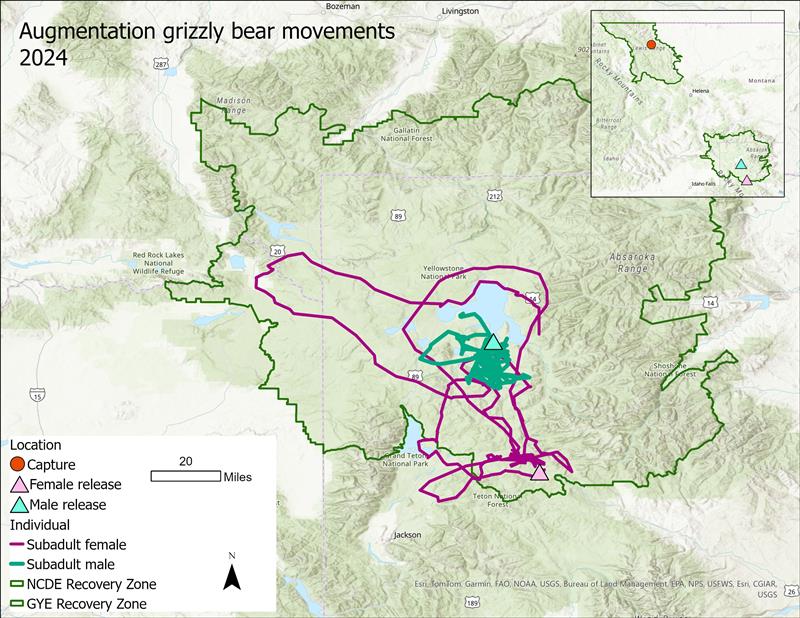 The bears were captured and collared within a day of each other southwest of east Glacier in a remote area of the Middle Fork of the Flathead River drainage in July and driven overnight to the GYE. One was a 3- to 4-year-old female; the other was a 4- to 5-year- old male.
“We were looking for the ideal bears,” McDonald said. “It’s actually not that easy to capture two bears that are prime candidates for translocation.”
In this case, the ideal bears were subadult, meaning they were older than cubs but not at sexual maturity yet, had no history of conflict and weighed enough to prepare for hibernation, McDonald said. Bears of this age are often in search of their permanent home range, therefore they are more likely to stay in the relocation than more mature individuals.
FWP worked with partners from the National Park Service and the Wyoming Game & Fish Department on the translocation destinations. The male bear was hauled by boat to the southern end of Yellowstone Lake. The female was taken to a remote location in the Blackrock Creek drainage west of Dubois, Wyo.
“We are very pleased to see that both bears have remained in the GYE, even staying mostly within remote areas of the Recovery Zone,” said Cecily Costello, FWP grizzly bear researcher. “It’s not always easy for a bear to adjust after being moved like this, but they seem to be settling in. We believe both have recently found a den site for the winter.”
Population recovery levels in the NCDE and GYE were passed several years ago. Montana has petitioned the U.S. Fish and Wildlife Service to delist bears in the NCDE, and Wyoming, with support from Montana and Idaho, has petitioned to delist grizzly bears in the GYE.
In both ecosystems, the states have met the delisting requirements and addressed concerns identified by the public or lined out by federal courts that have overturned previous delisting efforts. Those elements include:
* Reaching population recovery
* Having conflict prevention and response programs in place
* Continuing with research and monitoring
* Establishing a regulatory framework for managing grizzly bears once delisted
* Continuing with education and outreach about grizzly bears
* Safeguarding genetic health
According to McDonald, Montana and Wyoming have and will continue to act on their commitment to connectivity, and the agencies will continue to monitor the bears and their genetics to check for population diversity.
“That these bears are exploring their new ecosystem and seem to be doing well is an indication that they’ll thrive in their new environment,” McDonald said. “It also reflects the commitment Montana has to grizzly bear conservation.”
The lines show the movements of the female grizzly bear (pink) and male grizzly bear (green) that were relocated from the Northern Continental Divide Ecosystem (NCDE) to the Greater Yellowstone Ecosystem (GYE) this past summer. Both ecosystems have populations of grizzly bears that have surpassed recovery goals. However, the translocation effort was designed to help increase the genetic diversity of the GYE population, which has been isolated from nearby populations for many years. It’s an effort that may be repeated in the future, depending on how close the two populations eventually grow.
“This just jump starts what very likely will also happen naturally,” said Ken McDonald, head of Montana Fish, Wildlife & Parks’ Wildlife Division.
“We were looking for the ideal bears,” McDonald said. “It’s actually not that easy to capture two bears that are prime candidates for translocation.”
In this case, the ideal bears were subadult, meaning they were older than cubs but not at sexual maturity yet, had no history of conflict and weighed enough to prepare for hibernation, McDonald said. Bears of this age are often in search of their permanent home range, therefore they are more likely to stay in the relocation than more mature individuals.
FWP worked with partners from the National Park Service and the Wyoming Game & Fish Department on the translocation destinations. The male bear was hauled by boat to the southern end of Yellowstone Lake. The female was taken to a remote location in the Blackrock Creek drainage west of Dubois, Wyo.
“We are very pleased to see that both bears have remained in the GYE, even staying mostly within remote areas of the Recovery Zone,” said Cecily Costello, FWP grizzly bear researcher. “It’s not always easy for a bear to adjust after being moved like this, but they seem to be settling in. We believe both have recently found a den site for the winter.”
Population recovery levels in the NCDE and GYE were passed several years ago. Montana has petitioned the U.S. Fish and Wildlife Service to delist bears in the NCDE, and Wyoming, with support from Montana and Idaho, has petitioned to delist grizzly bears in the GYE.
In both ecosystems, the states have met the delisting requirements and addressed concerns identified by the public or lined out by federal courts that have overturned previous delisting efforts. Those elements include:
* Reaching population recovery
* Having conflict prevention and response programs in place
* Continuing with research and monitoring
* Establishing a regulatory framework for managing grizzly bears once delisted
* Continuing with education and outreach about grizzly bears
* Safeguarding genetic health
According to McDonald, Montana and Wyoming have and will continue to act on their commitment to connectivity, and the agencies will continue to monitor the bears and their genetics to check for population diversity.
“That these bears are exploring their new ecosystem and seem to be doing well is an indication that they’ll thrive in their new environment,” McDonald said. “It also reflects the commitment Montana has to grizzly bear conservation.”
Subscribe to:
Posts (Atom)